How to Fix Engine Hesitation When Accelerating
Engine hesitation when accelerating is one of the most frustrating problems a driver can experience. You press the throttle, and instead of the car responding smoothly, it stumbles, hesitates, or briefly loses power before catching up. Sometimes it’s barely noticeable — a slight flat spot at a specific RPM. Other times it’s severe enough to make the car feel dangerous in traffic.
Fixing engine hesitation when accelerating starts with understanding what’s actually happening. The engine needs three things in precise coordination to accelerate cleanly: the right amount of fuel, a strong spark at the right moment, and enough air flowing through the intake. A breakdown in any one of these — or in the sensors that manage them — causes the hesitation you feel.
This guide walks through every common cause of engine hesitation when accelerating, how to diagnose each one, and what it takes to fix it properly.
What Engine Hesitation When Accelerating Actually Feels Like
Before diving into causes, it helps to be specific about the symptom — because “hesitation” can mean different things, and the description often points toward the cause.
A flat spot at a specific RPM: The engine pulls fine everywhere else but stumbles at one particular point in the rev range — often between 1,500 and 2,500 RPM. This is classic throttle body or MAF sensor territory.
Hesitation from a cold start that clears up when warm: The engine stumbles for the first few minutes then runs normally. Points toward fuel delivery, cold start enrichment, or a coolant temperature sensor issue.
Hesitation that gets worse under load: Fine at light throttle but stumbles under hard acceleration or going uphill. Often points to fuel pressure, ignition, or a lean fuel mixture.
Hesitation with a rough idle: If the engine also idles roughly, the problem likely affects multiple cylinders — fuel system, ignition, or vacuum leaks are common causes.
Brief stumble then recovery: The engine hesitates for a split second and recovers. Often a lean spike from a MAF sensor or oxygen sensor giving the ECM bad data.
Noting exactly when and how the hesitation happens gives you a significant head start in diagnosis.
Common Causes of Engine Hesitation When Accelerating
1. Dirty or Failing Mass Air Flow Sensor
The mass air flow (MAF) sensor measures how much air is entering the engine so the ECM can calculate the correct fuel quantity. A MAF sensor contaminated with oil vapor, dust, or debris sends inaccurate readings — and the ECM responds with the wrong amount of fuel. The result is engine hesitation when accelerating, particularly at light to moderate throttle where the sensor’s accuracy matters most.
A dirty MAF sensor is one of the most common causes of engine hesitation when accelerating on modern fuel-injected vehicles. The fix is often as simple as cleaning the sensor with dedicated MAF cleaner spray — not carburetor cleaner, which damages the sensing element. If cleaning doesn’t resolve the hesitation, the sensor may need replacement.
2. Clogged or Faulty Fuel Injectors
Fuel injectors deliver a precise spray of fuel into each cylinder. When an injector is partially clogged, it can’t deliver the correct fuel quantity — particularly during the rapid fuel demand of acceleration. The affected cylinder runs lean momentarily, causing a hesitation or stumble.
Engine hesitation when accelerating from a fuel injector issue often feels like a slight miss or shudder rather than a complete stall. A quality fuel system cleaner added to the tank resolves mild clogging. More severe injector faults require professional ultrasonic cleaning or replacement.
3. Weak Fuel Pump or Low Fuel Pressure
The fuel pump must maintain adequate pressure to supply all injectors under the increased demand of acceleration. A pump that’s weakening can hold pressure at idle but drops off when the throttle opens — causing a momentary lean condition and engine hesitation when accelerating.
Low fuel pressure is particularly noticeable under hard acceleration or when climbing hills. A fuel pressure gauge test confirms whether the pump is maintaining the manufacturer’s specified pressure under load. If pressure drops during acceleration, the pump or fuel pressure regulator needs attention.
4. Faulty Throttle Position Sensor
The throttle position sensor (TPS) tells the ECM how far and how quickly the throttle plate is opening. When you press the accelerator, the ECM uses this signal to anticipate increased fuel demand and adjust accordingly. A faulty TPS sends incorrect opening rate data — and the ECM’s fuel delivery response lags behind the actual throttle movement. The result is a classic hesitation stumble at the beginning of acceleration.
Engine hesitation when accelerating that’s specifically worse when you first press the throttle — a surge or stumble right at tip-in — is a strong indicator of a TPS fault. Codes like P0120, P0121, or P0122 in the ECM confirm the diagnosis.
5. Dirty Throttle Body
Carbon and oil deposits build up on the throttle plate and bore over time, particularly on direct injection engines that don’t have fuel washing over the intake valves. A partially obstructed throttle body restricts airflow and causes the air-fuel mixture to go rich at idle and lean during the transition to acceleration — producing engine hesitation when accelerating from a standstill.
Cleaning the throttle body with dedicated throttle body cleaner resolves hesitation from this cause. On drive-by-wire vehicles, a throttle body relearn procedure may be necessary after cleaning to reset the ECM’s idle calibration.
6. Vacuum Leaks
Unmetered air entering the engine through a cracked vacuum hose, a failed intake manifold gasket, or a loose sensor port connection causes the air-fuel mixture to go lean. The ECM eventually compensates, but the lean spike during the transition creates engine hesitation when accelerating — often accompanied by a rough idle.
Vacuum leaks are a particularly common cause of engine hesitation when accelerating on older vehicles where rubber hoses have become brittle with age. Spraying carburetor cleaner carefully around suspect areas while the engine idles — watching for changes in idle speed — helps locate the leak. A smoke test is more thorough and the preferred method in a professional shop.
7. Worn Spark Plugs or Failing Ignition Coils
Ignition components are the most frequently overlooked cause of engine hesitation when accelerating. A spark plug that’s worn, fouled, or incorrectly gapped can fire adequately at idle but misfire under the higher cylinder pressure of acceleration — causing a stumble that feels exactly like a fuel issue. Similarly, an ignition coil that’s beginning to fail often passes at light load but breaks down under the voltage demand of acceleration.
If the vehicle has high mileage and the spark plugs haven’t been replaced recently, this is one of the cheapest and most effective first steps. Replacing plugs and checking coil resistance often resolves engine hesitation when accelerating without any further diagnosis.
8. Faulty Oxygen Sensor
The oxygen sensor measures exhaust oxygen content and feeds this data to the ECM for fuel trim corrections. A slow or lazy oxygen sensor doesn’t respond quickly enough to changes in fuel demand during acceleration — leaving the ECM working from stale data. The result is a brief rich or lean spike that causes engine hesitation when accelerating before the sensor catches up.
Oxygen sensor codes like P0130, P0133, or P0136 confirm this diagnosis. A slow-responding sensor often tests within resistance specification but shows its fault clearly on an oscilloscope — the waveform cycles too slowly compared to a healthy sensor.
9. EGR Valve Issues
The exhaust gas recirculation (EGR) valve recirculates a portion of exhaust gas back into the intake to reduce emissions and combustion temperatures. An EGR valve that’s stuck open allows exhaust gas into the intake at the wrong time — typically during acceleration when it should be closed. This dilutes the air-fuel mixture and causes engine hesitation when accelerating, often accompanied by a rough idle.
EGR-related engine hesitation when accelerating is more common on older vehicles and tends to be worst at low RPM. Codes P0401 or P0402 alongside the hesitation complaint point directly to the EGR system.
10. Clogged Catalytic Converter
A catalytic converter that’s partially blocked creates exhaust backpressure that restricts the engine’s ability to breathe freely. Under light load the restriction may be manageable, but during acceleration when exhaust flow increases significantly, the backpressure becomes severe enough to cause engine hesitation when accelerating — sometimes accompanied by a significant loss of power.
Testing for catalytic converter restriction involves measuring exhaust backpressure with a gauge at the oxygen sensor port. More than about 1.5 PSI at idle or 3 PSI at moderate RPM indicates excessive restriction. The P0420 code is a common companion fault when the catalytic converter is failing.
How to Diagnose Engine Hesitation When Accelerating
Step 1 — Scan for fault codes
The first step when addressing engine hesitation when accelerating is always an OBD2 scan. Even if the check engine light isn’t on, pending codes may be stored. Any code present narrows the diagnosis significantly — a MAF sensor code, an oxygen sensor code, or a TPS code all point directly to specific systems to investigate.
Step 2 — Check the MAF sensor
Disconnect the MAF sensor and test drive the car. Some vehicles run better without the MAF if it’s sending bad data — the ECM defaults to a base fuel map that may actually be more accurate than the corrupted MAF signal. If hesitation improves with the MAF disconnected, clean or replace the sensor.
Step 3 — Check for vacuum leaks
Inspect all vacuum hoses visually for cracks or disconnections. Use carburetor cleaner or a smoke tester to locate any leaks. Vacuum leaks causing engine hesitation when accelerating are often accompanied by a high or rough idle that worsens when the affected hose is disturbed.
Step 4 — Test fuel pressure
Connect a fuel pressure gauge to the fuel rail test port and monitor pressure at idle and during acceleration. Compare readings to the manufacturer’s specification. A pressure drop during acceleration confirms a fuel delivery fault as the cause of the hesitation.
Step 5 — Inspect spark plugs and ignition coils
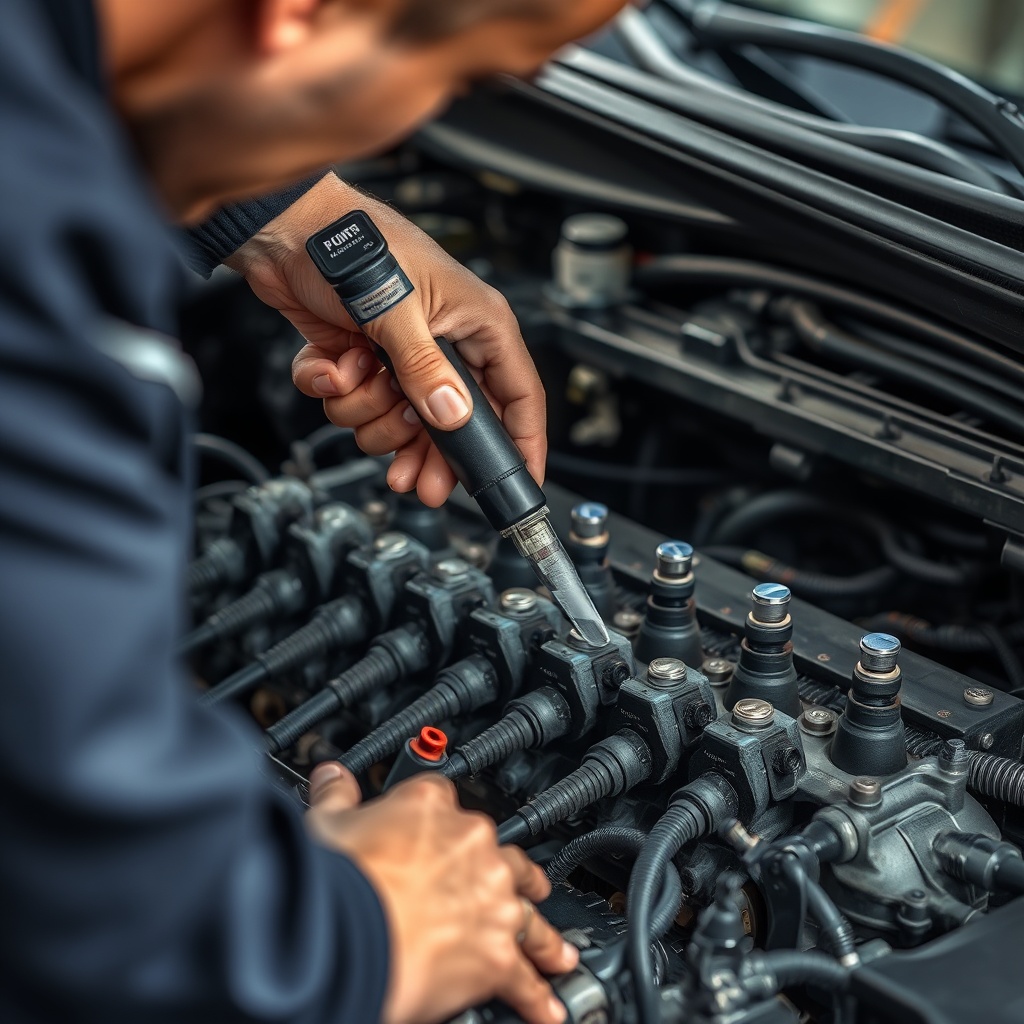
Pull the spark plugs and inspect them. Worn, fouled, or gap-eroded plugs are a common and inexpensive fix for engine hesitation when accelerating. Test coil resistance with a multimeter and compare to specification. On coil-on-plug engines, swapping a suspect coil to another cylinder confirms whether the coil is the cause.
Step 6 — Monitor live sensor data
Using a scan tool with live data capability, monitor MAF readings, TPS voltage, fuel trims, and oxygen sensor data while driving. A MAF reading that drops or spikes during acceleration, a TPS that shows erratic voltage, or fuel trims that swing wildly during throttle input all identify the specific sensor causing the engine hesitation when accelerating.
Step 7 — Check the EGR valve
On applicable vehicles, remove and inspect the EGR valve for carbon buildup and stuck-open conditions. Clean or replace as necessary. Clear any related codes and test for hesitation improvement.
How to Fix Engine Hesitation When Accelerating
Clean the MAF sensor — Use dedicated MAF sensor cleaner, allow to dry fully, and refit. This resolves a significant percentage of engine hesitation when accelerating complaints on modern vehicles and costs very little.
Replace spark plugs and check ignition coils — If the vehicle has high mileage or plugs haven’t been changed recently, replace the full set. Check each coil with a multimeter. This is often the most cost-effective first repair for engine hesitation when accelerating.
Fix vacuum leaks — Replace any cracked or disconnected hoses. Reseal intake manifold gaskets if leaking. This is inexpensive in parts and often dramatic in effect — a significant vacuum leak can cause severe hesitation that disappears immediately once sealed.
Clean the throttle body — Use dedicated throttle body cleaner and a soft cloth. Perform a throttle body relearn if the vehicle requires it. This often resolves hesitation from a standstill.
Address fuel delivery — Replace the fuel filter if serviceable. If fuel pressure is low under load, the pump needs replacement. Professional injector cleaning or replacement addresses injector-specific hesitation.
Replace faulty sensors — A confirmed MAF sensor, TPS, or oxygen sensor fault requires component replacement. Use OEM or quality aftermarket parts — cheap sensors often cause the same engine hesitation when accelerating to return shortly after replacement.
Service the EGR system — Clean or replace a stuck EGR valve. Check EGR passages for carbon buildup and clean as necessary.
What It Might Cost to Fix Engine Hesitation When Accelerating
| Repair | Estimated Cost |
|---|---|
| MAF sensor cleaning (DIY) | $10 – $20 |
| MAF sensor replacement | $80 – $300 |
| Spark plug replacement | $50 – $200 |
| Ignition coil replacement | $80 – $300 |
| Throttle body cleaning | $20 – $100 |
| Vacuum leak repair | $50 – $300 |
| Fuel pump replacement | $200 – $600 |
| Oxygen sensor replacement | $80 – $250 |
| EGR valve replacement | $150 – $400 |
| Catalytic converter replacement | $400 – $1,500 |
Costs vary by vehicle make, model, and labor rates in your area.
Related Articles
- P0300 — Random/Multiple Cylinder Misfire Detected
- P0171 — System Too Lean Bank 1
- P0420 — Catalyst System Efficiency Below Threshold
- How to Fix Check Engine Light — Full Guide
- Engine Misfiring: Symptoms, Causes & Solutions
Frequently Asked Questions
Why does my car hesitate when I first press the accelerator? A hesitation specifically at tip-in — right when you first press the throttle — is most commonly caused by a faulty throttle position sensor, a dirty throttle body, or a MAF sensor that can’t respond quickly enough to the sudden change in airflow. These components work together to manage the transition from idle to acceleration, and a fault in any one of them causes the stumble you feel.
Can bad spark plugs cause engine hesitation when accelerating? Yes — worn or fouled spark plugs are one of the most common causes of engine hesitation when accelerating. A plug that fires adequately at idle can misfire under the higher cylinder pressure of acceleration, causing a stumble that feels identical to a fuel delivery fault. Always check plugs as part of diagnosing hesitation, particularly on high-mileage vehicles.
Will a dirty air filter cause hesitation? A severely clogged air filter restricts airflow enough to cause hesitation under hard acceleration. Check the air filter first — it’s the cheapest and easiest thing to rule out when investigating engine hesitation when accelerating.
Can low fuel pressure cause hesitation only under acceleration? Yes. A fuel pump that’s weakening can maintain adequate pressure at idle but drops off when the throttle opens and fuel demand increases. The engine runs lean for a moment, causing hesitation, before pressure stabilizes. This is a classic sign of a fuel pump approaching the end of its life.
How do I know if it’s the MAF sensor or a vacuum leak causing hesitation? A vacuum leak typically causes a rough idle alongside the hesitation. A MAF sensor issue more often produces a smooth idle with hesitation only during throttle transitions. Disconnecting the MAF sensor and test driving — the ECM defaults to a base map — helps confirm if the MAF signal is the problem. If hesitation improves with the MAF disconnected, the sensor is the cause.
For more information on engine diagnostics and OBD-II standards, visit the National Highway Traffic Safety Administration (NHTSA).
This guide is for informational purposes only. For an accurate diagnosis, always consult a qualified mechanic.