Why Is My Check Engine Light On?
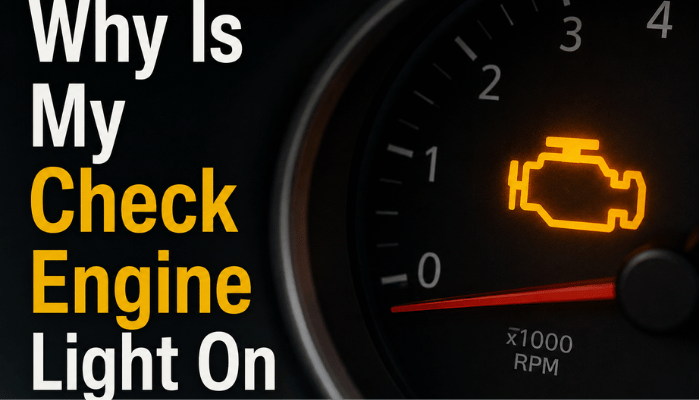
The check engine light came on. Now what?
Why Is My Check Engine Light On? First: don’t panic. It’s rarely an emergency. But it’s also not something to ignore for weeks. Here’s how to figure out what’s going on and what to do about it.
What the Check Engine Light Actually Is
Your car’s computer (ECM/PCM) constantly monitors dozens of sensors across the engine, transmission, and exhaust system. When a reading falls outside acceptable limits, it logs a Diagnostic Trouble Code (DTC) and turns on the check engine light.
The light itself doesn’t tell you what’s wrong — it just tells you that something has been flagged. That something could be a loose gas cap or a failing catalytic converter. The only way to know is to read the code.
Solid light vs. flashing light:
- Solid — An issue has been detected. Not urgent in most cases, but get it checked soon.
- Flashing — Active misfire that could damage the catalytic converter. Pull over when safe and don’t drive hard until it’s diagnosed.
Most Common Reasons It Comes On
1. Loose or Damaged Gas Cap
The most common and the easiest fix. A loose gas cap triggers a fuel vapor leak code (P0457 or similar) because the evaporative emissions system can’t hold pressure.
Fix: Tighten the cap until it clicks. If the cap is cracked or the seal is worn, replace it ($10–$20). Clear the code and see if it returns.
2. Oxygen Sensor Failure
O2 sensors measure oxygen in the exhaust to help the ECM manage the air-fuel ratio. They typically last 60,000–100,000 miles. A failing sensor causes poor fuel economy, higher emissions, and can eventually damage the catalytic converter.
Common codes: P0136, P0141, P0131, P0137
3. Catalytic Converter Degrading
If the check engine light has been on for a while with no action taken, or if the car has high mileage, the catalytic converter may be losing efficiency. Often caused by a long-ignored O2 sensor or misfire problem.
Common code: P0420, P0430
Symptom: Rotten egg smell from the exhaust, reduced performance at higher RPMs.
4. Mass Airflow (MAF) Sensor Problem
The MAF sensor measures how much air enters the engine. A dirty or failing MAF causes rough idling, hesitation, poor fuel economy, and sometimes stalling.
Common codes: P0100, P0101, P0102
Quick fix to try first: Spray the MAF sensor wires with MAF cleaner spray ($8). A surprising number of MAF codes clear after a simple cleaning.
5. Spark Plugs or Ignition Coils
Worn spark plugs or a failing ignition coil cause engine misfires. You’ll often feel this — a rough idle, hesitation when accelerating, or a slight shudder. In severe cases, the check engine light flashes.
Common codes: P0300 (random misfire), P0301–P0308 (specific cylinder)
Note: Modern spark plugs last 60,000–100,000 miles, but ignition coils can fail at any mileage.
6. Vacuum Leak
A cracked hose, loose clamp, or torn intake boot lets unmetered air into the engine. The ECM can’t account for it, and the result is a lean condition and rough running.
Common codes: P0171, P0174
How to find it: With the engine running, spray carburetor cleaner around vacuum lines and intake joints. If the idle changes, you’ve found the leak.
7. EGR Valve Issue
The Exhaust Gas Recirculation valve recirculates a portion of exhaust back into the intake to reduce emissions. When it sticks open or closed, it affects combustion and triggers codes.
Common codes: P0400, P0401, P0402
8. EVAP System Leak
The evaporative emission control system captures fuel vapors. Any leak — from a cracked hose to a bad purge valve — triggers an EVAP code. These rarely affect drivability but will cause an emissions test failure.
Common codes: P0440, P0442, P0455
What to Do First
Step 1 — Check the gas cap Remove it and reinstall it firmly. It sounds too simple, but it’s the cause of a surprising number of check engine lights.
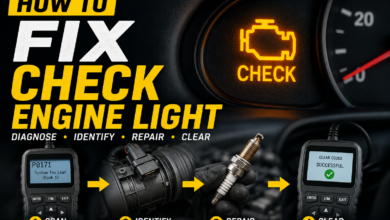
Step 2 — Read the code You need an OBD2 scanner to know what you’re actually dealing with. Basic scanners cost $25–$50 and plug into the port under your dashboard (driver’s side, near the steering column). Many auto parts stores (AutoZone, O’Reilly, Advance Auto) will also read codes for free.
Don’t guess without reading the code first — you’ll waste time and money.
Step 3 — Look up the specific code Once you have the code (e.g., P0420, P0171), you can research the specific cause. Each code has a defined meaning and a defined list of causes to work through.
Step 4 — Assess urgency
- Flashing light → treat as urgent, avoid hard driving
- Solid light + car running normally → not urgent, but don’t ignore it for weeks
- Solid light + noticeable performance issues → investigate soon
What Not to Do
Don’t just clear the code and hope it goes away. The code is a symptom. Clearing it without fixing the cause means it will return — and you’ll fail any emissions test in the meantime because the readiness monitors need time to reset.
Don’t assume the worst. Most check engine lights are minor issues. A loose gas cap, a dirty MAF sensor, or a worn O2 sensor are all common and inexpensive fixes.
Don’t ignore a flashing light. A flashing check engine light means active misfires are occurring right now. Unburned fuel entering the catalytic converter can destroy it within minutes of hard driving. Pull over and get it diagnosed.
Will It Go Away on Its Own?
Sometimes. If the issue was temporary — a brief sensor glitch, a loose gas cap you’ve since tightened — the ECM may clear the code after a few drive cycles with no recurrence.
But if the underlying problem is still there, the light will stay on or come back quickly after clearing. Don’t count on it going away by itself.
Frequently Asked Questions
Can I drive with the check engine light on? Usually yes, if it’s solid and the car drives normally. Avoid highway driving if the light is flashing. Either way, get it read soon — some problems that feel minor get worse quickly.
How long can I drive with it on? There’s no hard limit, but every week you wait is a week the underlying issue can worsen. Some problems (like a lean condition) can cause damage to other components over time.
Will it turn off after I fix the problem? Sometimes the ECM clears it automatically after a few successful drive cycles. If not, you’ll need to clear it manually with a scanner.
My car runs fine — why is it on? Many issues don’t affect drivability in the early stages. Emissions-related problems (EVAP leaks, degrading O2 sensors, early catalytic converter wear) often have no noticeable symptoms until they’re well advanced.
The light came on right after I got gas — what happened? Almost certainly the gas cap. Tighten it, drive normally for a day or two, and see if the light clears on its own.
Common Codes Quick Reference
| Code | Meaning | Urgency |
|---|---|---|
| P0420 / P0430 | Catalytic converter efficiency low | Medium |
| P0171 / P0174 | Running lean (too much air) | Medium |
| P0300–P0308 | Engine misfire | High if flashing |
| P0455 | Large EVAP leak (often gas cap) | Low |
| P0101 | MAF sensor problem | Medium |
| P0136 / P0141 | O2 sensor failure | Medium |
| P0401 | EGR flow insufficient | Low–Medium |
Reading the code is always the first step. Without it, you’re guessing — and guessing gets expensive fast.