How to Reset OBD2 Codes Without a Scanner You fixed the problem, but the check engine light is still on. Or maybe you just want to clear a code and see if it comes back. Either way, you don’t have a scanner — so here’s what you can actually do.
Before You Reset Anything
One important thing first: resetting a code doesn’t fix the problem that caused it.
If the underlying issue is still there, the light will come back within a few drive cycles — sometimes within minutes. Resetting makes sense after you’ve already made a repair, or when you want to test whether a code returns. It doesn’t make sense as a substitute for diagnosing the problem.
With that said, here are the methods that actually work.
Method 1: Disconnect the Battery (Most Reliable)
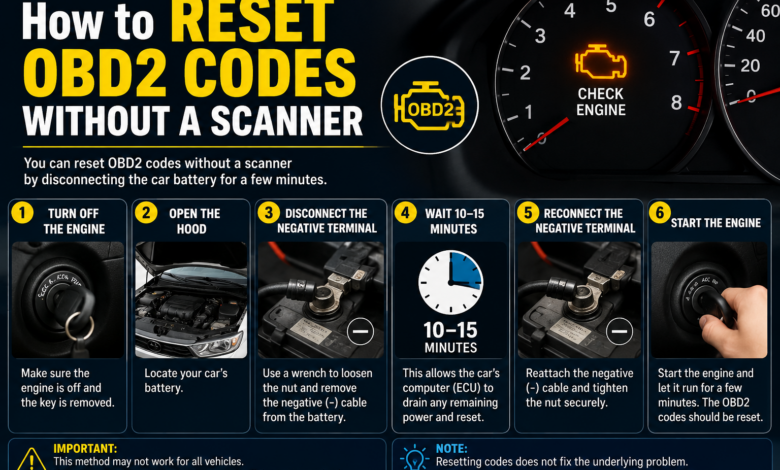
This is the most effective way to clear codes without a scanner. Cutting power to the ECM forces it to lose its stored fault memory.
What you need: A wrench (usually 10mm)
Steps:
- Turn the ignition off and remove the key
- Open the hood and locate the battery
- Loosen and remove the negative terminal first (the black one marked with a minus sign) — this is important for safety
- Leave it disconnected for 15–20 minutes — this gives the capacitors in the ECM time to fully drain
- Reconnect the negative terminal and tighten it securely
- Start the car and let it idle for a few minutes
The check engine light should be gone. If it comes back within a short drive, the fault is still present.
What you’ll lose:
- Radio presets and saved stations
- Power window auto-up/down calibration (on some cars)
- The ECM’s learned fuel trim data — the car may idle slightly rough for a short period while it relearns
- Clock settings
What you won’t lose:
- Any permanent vehicle data or settings
- Nothing that can’t be reset in a few minutes
Method 2: The Ignition Cycle Method (Hit or Miss)
This method works on some older vehicles but is not reliable on modern ones. It’s worth trying if you don’t want to disconnect the battery.
Steps:
- Make sure the ignition is fully off
- Turn the key to the ON position (not start — just until the dashboard lights come on)
- Wait 2–3 seconds
- Turn the key back to OFF
- Repeat this ON/OFF cycle 3 times
- On the third cycle, leave it in ON and watch the check engine light
On vehicles where this works, the light will blink and then go off. On most modern cars, it won’t do anything.
Why it’s unreliable: Modern ECMs don’t reset from ignition cycling. This method was more relevant on pre-2000 vehicles. If it doesn’t work after trying it twice, move on to the battery disconnect method.
Method 3: Pull the ECM Fuse (Alternative to Battery Disconnect)
If you’d rather not disconnect the battery — maybe you don’t want to lose radio presets — you can pull the ECM fuse instead. It achieves a similar result.
Steps:
- Locate your fuse box (usually under the dashboard on the driver’s side, or under the hood)
- Find the fuse labeled “ECM,” “ECU,” or “Engine Control” — check your owner’s manual for the exact location
- Pull the fuse with fuse pullers or needle-nose pliers
- Wait 15 minutes
- Reinsert the fuse
- Start the car
This clears the ECM memory without affecting radio presets or other settings. Not all vehicles have a clearly labeled ECM fuse, so check your owner’s manual first.
Method 4: Drive It Out (Slowest Option)
If you’ve fixed the problem and just want the light to clear on its own, you can simply drive normally. The ECM runs diagnostic checks called “readiness monitors” during normal driving. Once those monitors complete without detecting a fault, the light clears on its own — typically within 3–5 drive cycles.
A drive cycle includes: cold start, warm-up period, steady highway speed, deceleration, and stop-and-go driving. One full day of normal mixed driving usually covers it.
This is the most hands-off approach but also the slowest.
Will the Light Come Back?
That depends entirely on whether the original problem was fixed.
- Light stays off → The fault is resolved, or it was a temporary glitch
- Light comes back immediately → The fault is still active
- Light comes back after a few days → The fault is intermittent — it needs proper diagnosis
If the light keeps returning after resetting, you need to read the code and address the actual cause. A $25–$50 OBD2 scanner is the right tool at that point — or most auto parts stores will read codes for free.
What You Should Know About Readiness Monitors
When you clear codes (by any method), the ECM also resets its readiness monitors — the internal tests it runs on the emissions systems. These monitors need to complete before:
- The check engine light will stay off permanently
- You can pass an emissions/smog test
If you clear codes right before an emissions test, you’ll likely fail — not because the light is on, but because the monitors show “incomplete.” You need to drive normally for several days first to let them reset.
Quick Comparison
| Method | Reliability | Time | What You Lose |
|---|---|---|---|
| Battery disconnect | High | 20 min | Radio presets, clock |
| ECM fuse pull | High | 20 min | Usually nothing |
| Ignition cycling | Low (older cars only) | 5 min | Nothing |
| Drive it out | High (if problem fixed) | 1–3 days | Nothing |
Frequently Asked Questions
Does disconnecting the battery damage the car? No. It’s a standard procedure that mechanics do regularly. The only downside is losing minor settings like radio presets. The ECM itself is not harmed.
How long do I need to leave the battery disconnected? 15–20 minutes is enough for the capacitors to drain fully. Longer doesn’t hurt, but shorter may not fully clear the memory.
My light came back after 2 minutes — what does that mean? The fault is still active. The problem hasn’t been fixed, or the issue is occurring continuously. You need to diagnose the root cause.
Can I reset codes before an emissions test? Technically yes, but it usually backfires. Cleared readiness monitors cause an automatic failure at most emissions stations regardless of whether the light is on. Drive normally for at least a week after clearing codes before going for a test.
Is it bad to drive with the check engine light on? It depends on the code. A solid light with no drivability issues is usually okay in the short term. A flashing light means active misfires — don’t drive hard until it’s diagnosed.
Resetting codes is a tool, not a solution. If the light keeps coming back, the car is telling you something needs attention — and eventually, it’s worth listening.