P0442 Code: Evaporative Emission Control System Leak Detected
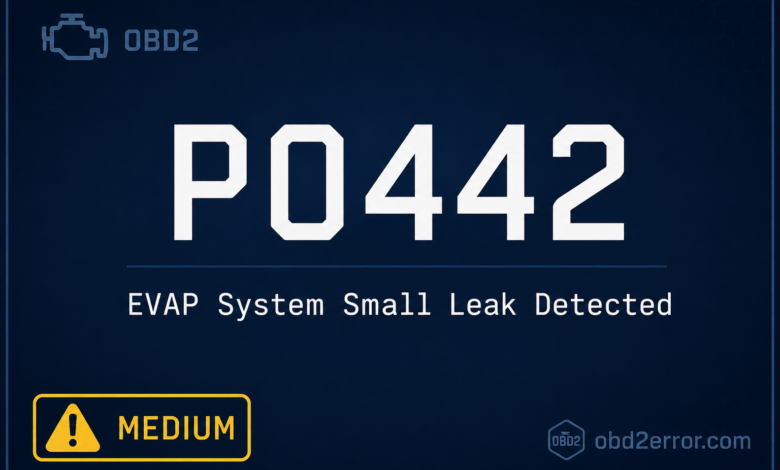
The P0442 code means your vehicle’s onboard diagnostic system has detected a small leak in the evaporative emission control system — the EVAP system. When the P0442 code is stored, the ECM has determined that fuel vapors are escaping from somewhere in the sealed system that’s supposed to contain them.
The good news: the P0442 code is one of the few check engine light codes where the fix is sometimes as simple as tightening a loose gas cap. The less good news: it’s also one of the trickier codes to diagnose when the fix isn’t that simple — because EVAP system leaks are often invisible to the eye and require specialized equipment to locate.
The P0442 code won’t leave you stranded. Your car will run normally with this fault stored. But it will fail an emissions test, and a small leak that’s ignored has a way of becoming a larger one. Understanding what the P0442 code means and how to approach it efficiently saves time, money, and frustration.
What Is the EVAP System?
Before diagnosing the P0442 code, it helps to understand what the EVAP system actually does — because it’s one of the least understood systems on a modern vehicle.
Gasoline evaporates. Even in a sealed fuel tank, fuel constantly produces vapor. Without a containment system, those vapors would vent to the atmosphere — contributing to smog and wasting fuel. The evaporative emission control system captures those vapors and routes them to the engine to be burned during normal operation.
The system consists of the fuel tank, a charcoal canister that stores fuel vapors, a purge valve that releases stored vapors into the intake manifold when conditions are right, a vent valve that controls fresh air flow into the canister, fuel lines, vapor lines, and the fuel filler neck and cap. Every connection in this system is a potential leak point — and any leak small enough to store the P0442 code but not large enough for P0455 (large leak) falls into the “small leak” category, which SAE defines as a leak equivalent to a hole of approximately 0.020 inches or smaller.
The ECM tests the EVAP system periodically — usually during specific drive conditions after a cold start — by sealing the system and monitoring for pressure loss. If pressure drops faster than expected, the P0442 code is stored.
What You’ll Notice
- Check engine light on — often the only symptom
- Faint smell of fuel, particularly after parking or in hot weather
- Slightly reduced fuel economy in some cases
- Vehicle may fail an emissions test
- No drivability issues — the P0442 code doesn’t affect how the car drives
The P0442 code is one of those faults that’s easy to dismiss because the car seems perfectly fine. No rough idle, no hesitation, no stalling. The check engine light is on, but everything else feels normal. This is exactly why the P0442 code gets ignored for longer than it should — and why that small leak sometimes grows into a larger one.
What Usually Causes the P0442 Code
1. Loose, damaged, or missing fuel cap The most common cause of the P0442 code — and the first thing to check. The fuel cap seals the top of the filler neck and is part of the EVAP system. A cap that isn’t fully tightened, has a cracked or hardened seal, or has been replaced with a non-OEM cap that doesn’t seal properly allows vapor to escape and stores the P0442 code.
Tighten the cap until it clicks, clear the code, and drive for a few days. If the P0442 code doesn’t return, the cap was the cause. If it returns, or if the cap is visibly cracked or damaged, replace it with an OEM or OEM-equivalent cap. Aftermarket gas caps are a surprisingly common cause of recurring P0442 codes — they may fit the filler neck but fail to seal to the pressure spec the EVAP system requires.
2. Cracked or disconnected EVAP hose The vapor lines that connect the fuel tank, charcoal canister, purge valve, and intake manifold are typically made of rubber or plastic. Over time — particularly on vehicles with 8–15 years of heat cycling — these hoses crack, harden, or pull away from their fittings. A small crack in an EVAP hose is often invisible without pressurizing the system, making this a common cause of P0442 codes that don’t resolve with a gas cap replacement.
3. Faulty purge valve The purge valve (also called the purge solenoid) is an electrically controlled valve that opens to allow stored fuel vapors into the intake manifold. When this valve fails in a partially open position, it creates a continuous leak path in the EVAP system — causing the P0442 code even with all hoses and the fuel cap in perfect condition. A purge valve stuck open also often causes a rough idle because it allows unmetered vapor into the intake.
4. Faulty vent valve The vent valve controls the flow of fresh air into the charcoal canister. A vent valve that’s stuck open or has a damaged seal allows vapors to escape through the vent circuit, storing the P0442 code. Vent valve faults are less common than purge valve faults but produce identical P0442 code symptoms.
5. Damaged charcoal canister The charcoal canister absorbs and stores fuel vapors until the purge valve opens to send them to the engine. A canister that’s cracked, saturated from repeated overfilling of the fuel tank, or physically damaged stores the P0442 code because it can no longer contain vapors under the system’s test pressure. Overfilling the fuel tank — pumping past the first auto-stop click — is a known cause of charcoal canister saturation.
6. Leak at the fuel tank A crack, a failed seal, or a damaged filler neck connection at the fuel tank allows vapor to escape and causes the P0442 code. Fuel tank leaks are less common than vapor hose or valve issues but do occur on older vehicles — particularly where road salt or corrosion has affected the tank or its connections.
7. Leak at the filler neck The filler neck — the tube that connects the fuel cap to the fuel tank — can develop cracks or rust through on older vehicles. A leak at the filler neck stores the P0442 code and is often accompanied by a stronger fuel smell than a vapor line leak because it’s closer to the top of the system.
How Serious Is the P0442 Code?
Low severity — but don’t ignore it indefinitely.
The P0442 code won’t damage the engine, won’t leave you stranded, and won’t cause drivability problems. Your car runs normally. But there are three reasons not to leave it unaddressed:
First, fuel vapor leaks contribute to smog and are an EPA violation — which is why the P0442 code triggers the check engine light in the first place.
Second, a vehicle with the P0442 code will fail an emissions test in states and countries that require them. That means you can’t renew your registration without fixing it.
Third, a small leak can grow. A crack in an EVAP hose that causes the P0442 code today can become a larger leak — and a P0455 code — if left to deteriorate further. Fix it while it’s small.
How to Diagnose the P0442 Code
Step 1 — Check the fuel cap first
Remove the fuel cap, inspect the rubber seal for cracks or hardening, and check the cap for physical damage. Reinstall it firmly until it clicks. Clear the P0442 code and drive normally for 2–3 days to allow the EVAP system monitor to run its test. If the P0442 code doesn’t return, the cap was the cause.
If the cap is clearly damaged, replace it before clearing the code. Use an OEM cap or a quality OEM-equivalent — not a generic aftermarket cap.
Step 2 — Check for companion codes
Scan for all stored codes. A P0442 code stored alongside P0455 (large leak) or P0456 (very small leak) suggests multiple faults or a fault that’s inconsistent in size. P0442 alongside P0496 (purge valve flow) strongly suggests the purge valve is stuck open. Companion codes guide you toward specific components before touching anything.
Step 3 — Visual inspection of EVAP components
With the engine off, inspect all visible EVAP system components:
- Vapor hoses from the fuel tank to the canister and from the canister to the engine — look for cracks, splits, or disconnected ends
- The charcoal canister — look for cracks or physical damage
- The purge valve and its connections
- The filler neck — look for rust, cracks, or separation at the connection to the fuel tank
On many vehicles, the charcoal canister and most of the vapor lines are under the vehicle near the fuel tank — a flashlight and a creeper make this inspection much easier.
Step 4 — Test the purge valve
Disconnect the electrical connector from the purge valve and apply 12V to the valve terminals. You should hear and feel it click open. With the valve open, blow through it — air should pass freely. With the connector reconnected and the valve closed (ignition off), the valve should be sealed — you should not be able to blow through it at all. A valve that flows air when closed is stuck open and is causing the P0442 code.
Step 5 — Smoke test
The definitive diagnosis method for the P0442 code. A smoke machine pressurizes the EVAP system with visible smoke, revealing exactly where vapor is escaping — even from leaks too small to see or smell. Most professional shops have smoke machines, and the test typically takes 15–30 minutes. If you’ve replaced the gas cap and the P0442 code keeps returning, a smoke test is the most efficient path to finding the leak.
Step 6 — Monitor EVAP system data
Use a scan tool with live data capability to monitor the EVAP system. Some advanced scanners can show fuel tank pressure, purge valve duty cycle, and vent valve status in real time. A fuel tank that loses pressure faster than expected during the EVAP monitor test confirms the P0442 code is genuine rather than a false positive.
How to Fix the P0442 Code
Replace the fuel cap — Start here. An OEM replacement cap costs $15–30 and resolves the P0442 code in a significant percentage of cases. If the code returns after a new cap, move to the next step.
Replace the purge valve — If the purge valve test confirms it’s stuck open, replace it. Purge valves are typically located on or near the intake manifold and are accessible without major disassembly on most vehicles. They’re inexpensive and the replacement is straightforward.
Repair or replace EVAP hoses — Cracked or disconnected vapor hoses identified during inspection or smoke test need replacement. On many vehicles, specific sections of hose are available as repair parts. On others, the full vapor line assembly needs replacing.
Replace the vent valve — If the vent valve is faulty, replace it. Vent valves are usually located near the charcoal canister, which is often under the vehicle near the fuel tank.
Replace the charcoal canister — A saturated or physically damaged canister needs replacement. Avoid overfilling the fuel tank in future — stopping at the first auto-stop click prevents canister saturation.
Repair the filler neck or fuel tank — Rust or physical damage to the filler neck or tank requires repair or replacement. This is the most labor-intensive P0442 code repair and typically requires dropping the fuel tank.
P0442 on Specific Vehicle Makes
Chevrolet / GM (Silverado, Tahoe, Impala, Traverse): The P0442 code is extremely common on GM vehicles. The purge valve and vent valve are frequent failure points on Silverado and Tahoe. On Impala, cracked EVAP hoses near the fuel tank are a known cause. GM vehicles also commonly develop the P0442 code from non-OEM gas caps.
Toyota (Camry, Corolla, Highlander, Sienna): Toyota’s EVAP system is generally reliable, but the P0442 code appears on high-mileage Camry and Corolla models from deteriorated vapor hoses. The charcoal canister on some Toyota models can be damaged by frequent overfilling of the fuel tank.
Ford (F-150, Expedition, Ranger, Mustang): On Ford F-150 and Expedition, the P0442 code often relates to the EVAP vent valve or deteriorated vapor lines near the fuel tank. The F-150’s large fuel tank and complex EVAP routing make smoke testing particularly useful for pinpointing P0442 leaks.
Honda (Pilot, CR-V, Accord, Odyssey): Honda’s P0442 code frequently involves the purge valve or EVAP canister. The Honda Pilot is one of the higher-occurrence models for P0442 code faults. Honda EVAP systems are sensitive to non-OEM fuel caps — always use OEM replacement caps on Honda vehicles.
Nissan (Altima, Titan, Murano): Nissan’s Altima is one of the most commonly affected vehicles for the P0442 code. The purge solenoid and vapor hose connections near the fuel tank are common failure points on Altima and Murano.
What It Might Cost to Fix the P0442 Code
| Repair | Estimated Cost |
|---|---|
| OEM fuel cap replacement | $15 – $35 |
| Purge valve replacement | $50 – $200 |
| Vent valve replacement | $50 – $150 |
| EVAP hose repair / replacement | $50 – $300 |
| Charcoal canister replacement | $150 – $400 |
| Filler neck replacement | $200 – $600 |
| Smoke test (diagnosis) | $75 – $150 |
The P0442 code is one of the most cost-variable check engine light repairs — from a $15 gas cap to a $600 filler neck. A smoke test before throwing parts at the problem saves money in the long run.
Related Codes
- P0440 — Evaporative Emission Control System Malfunction
- P0441 — Evaporative Emission Control System Incorrect Purge Flow
- P0443 — Evaporative Emission Control System Purge Control Valve Circuit
- P0446 — Evaporative Emission Control System Vent Control Circuit
- P0455 — Evaporative Emission Control System Large Leak Detected
- P0456 — Evaporative Emission Control System Very Small Leak Detected
- P0496 — Evaporative Emission System High Purge Flow
- P0420 — Catalyst System Efficiency Below Threshold
- P0171 — System Too Lean Bank 1
Frequently Asked Questions
Can I drive with the P0442 code? Yes — the P0442 code doesn’t affect drivability. Your car starts, runs, and drives normally. However, you’ll fail an emissions test with the P0442 code active, and the underlying leak should be fixed to prevent it from worsening.
Will tightening the gas cap fix the P0442 code? Sometimes — and it’s always the right first step. If the cap was loose, tighten it firmly, clear the code, and drive for a few days. If the P0442 code returns, the leak is somewhere else in the EVAP system.
How long does it take for the P0442 code to clear after fixing the leak? After the repair, clear the code with a scanner and drive normally. The EVAP system monitor runs under specific conditions — typically a cold start followed by a drive cycle that includes highway and city driving. Most vehicles complete the monitor within 1–3 drive cycles. The check engine light won’t turn off until the monitor confirms the leak is gone.
Can overfilling the fuel tank cause the P0442 code? Yes. Pumping fuel past the first auto-stop click forces liquid fuel into the charcoal canister, saturating the activated carbon and damaging its vapor-absorption ability. A saturated canister eventually stores the P0442 code. Always stop fueling at the first click.
Is a smoke test worth the cost for P0442? Usually yes — if the gas cap replacement didn’t fix it. EVAP leaks are notoriously difficult to find without pressurizing the system, and a smoke test typically costs $75–$150. That’s cheaper than replacing the purge valve, canister, and hoses one at a time hoping to find the leak by trial and error.
Why does the P0442 code come back after I replaced the gas cap? The leak is somewhere else in the EVAP system. The gas cap is the most common cause but not the only one. If the P0442 code returns after a new OEM cap, the next steps are a visual inspection of EVAP hoses and valves, followed by a smoke test if the leak isn’t visible.
Will the P0442 code fail an emissions test? Yes — in all states and countries that require emissions testing. A stored P0442 code with an illuminated check engine light is an automatic failure. Fix the P0442 code before your test.
For more information on EVAP system regulations and vehicle emissions standards, visit the Environmental Protection Agency (EPA) or the National Highway Traffic Safety Administration (NHTSA).
This guide is for informational purposes only. For an accurate diagnosis, always consult a qualified mechanic.