P0321 Code: Ignition/Distributor Engine Speed Input Circuit Range/Performance
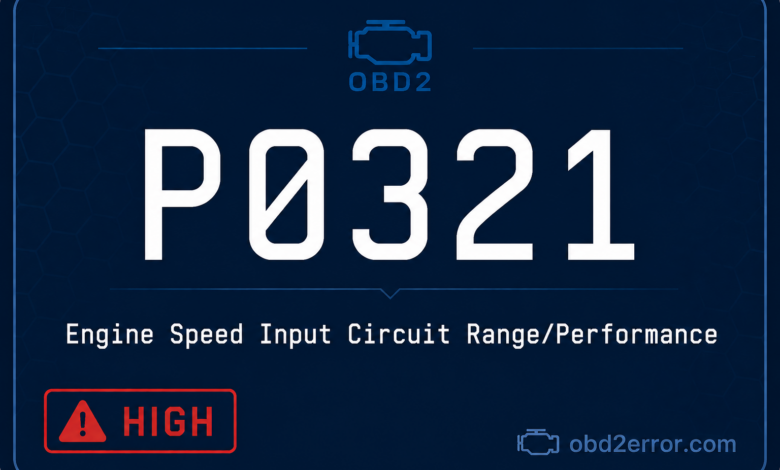
The P0321 code means your engine control module detected that the engine speed input circuit is producing a signal — but that signal is outside the expected range or performing poorly. It’s closely related to the P0320 code, but there’s an important difference: P0320 means the signal is missing entirely, while the P0321 code means the signal exists but isn’t behaving the way it should.
Think of it like a speedometer that works but gives you wrong numbers. The ECM is receiving something from the crankshaft position sensor or distributor pickup, but the data doesn’t match what the engine’s other parameters suggest. When that mismatch gets large enough, the P0321 code is stored.
This kind of fault is often intermittent — the sensor works fine most of the time, then produces an erratic signal under certain conditions like high heat, cold startup, or heavy load. That’s what makes the P0321 code tricky to catch.
What You’ll Notice
- Check engine light on
- Intermittent stalling, especially at idle or low speed
- Rough or erratic idle
- Hesitation during acceleration
- Hard starting, particularly when hot or cold
- Occasional misfires with no consistent pattern
- Engine running rough under load but smoothing out at cruise
The intermittent nature of P0321 symptoms is one of the biggest clues. If the problem comes and goes without a clear pattern, a sensor that’s producing an inconsistent signal is often behind it.
What Usually Causes the P0321 Code
1. Failing crankshaft position sensor The most common cause of the P0321 code. A sensor that’s starting to fail doesn’t always die completely — it often produces a signal that’s weak, erratic, or inconsistent under certain conditions. Heat is a common trigger: the sensor works fine cold but fails when the engine reaches operating temperature.
2. Damaged reluctor ring A reluctor ring with a missing tooth, a crack, or debris buildup creates irregular gaps in the signal. The ECM receives a pulse pattern that doesn’t match expectations, triggering the P0321 code even if the sensor itself is working perfectly. You can read more about how these systems work at How Stuff Works — Engine Sensors.
3. Wiring issues Intermittent wiring faults — a wire that makes contact most of the time but not always — are a classic cause of range and performance codes like P0321. Vibration, heat cycling, and age all contribute to wiring that works fine at rest but fails under real-world conditions.
4. Incorrect sensor air gap The crankshaft position sensor must sit at a precise distance from the reluctor ring. A sensor that’s slightly loose or was installed with the wrong gap produces a signal that varies with engine speed and load — exactly the kind of performance issue the P0321 code is designed to flag.
5. Distributor wear (older vehicles) On distributor-equipped engines, wear inside the distributor — shaft play, a worn pickup coil, or a loose reluctor — causes the engine speed signal to become inconsistent. As the P0320 code can appear when the signal is lost entirely, P0321 appears when the signal degrades before it disappears.
6. EMI interference Electromagnetic interference from a nearby component — a failing alternator, a bad ground, or aftermarket electronics — can corrupt the crankshaft position sensor signal and trigger the P0321 code without any physical fault in the sensor itself.
How Serious Is the P0321 Code?
Serious — and deceptively so.
Because the P0321 code often produces intermittent symptoms, it’s easy to dismiss. The car seems mostly fine, and the problem comes and goes. But a sensor that’s producing an unreliable signal is a sensor that’s on its way to failing completely. When it does, you may find yourself with a no-start condition and a P0320 code instead.
A vehicle that stalls unexpectedly at speed is also a safety risk — and intermittent stalling is one of the most common complaints associated with P0321.
How to Diagnose the P0321 Code
Step 1 — Read all stored codes
Confirm P0321 and look for companion codes. P0320 alongside P0321 means the signal is both absent at times and erratic at others — pointing strongly at the sensor or reluctor ring. P0335 or P0336 alongside P0321 gives you additional circuit information.
Step 2 — Check the sensor mounting and gap
Locate the crankshaft position sensor and confirm it’s properly secured. A sensor that’s come slightly loose will produce exactly the range and performance issues that trigger P0321. Verify the gap against your vehicle’s service specification — typically 0.5–1.5mm.
Step 3 — Inspect the wiring and connector
With the engine cold and off, inspect the sensor connector for corrosion, bent pins, and loose fit. Gently flex the wiring harness near the sensor — any change in resistance when you move the wire indicates an intermittent fault that won’t show up in a static test.
Step 4 — Inspect the reluctor ring
With the sensor removed, rotate the crankshaft by hand if possible and visually inspect the reluctor ring for missing teeth, cracks, or debris. Even one missing tooth causes an irregular signal pattern that the ECM flags as a P0321 code.
Step 5 — Monitor live data
Connect a scan tool capable of live data and watch the engine RPM signal while the engine runs. An RPM reading that fluctuates erratically, drops suddenly, or shows spikes that don’t match actual engine behavior confirms the signal is unreliable — even if the sensor seems to work at rest.
Step 6 — Oscilloscope test
An oscilloscope gives you the most complete picture of the crankshaft position sensor signal. A healthy sensor produces a clean, consistent waveform. Dropouts, noise, or irregular pulse spacing in the waveform confirms the P0321 code diagnosis before you spend money on parts.
How to Fix the P0321 Code
Replace the crankshaft position sensor — If the sensor is producing an inconsistent signal and all other causes have been ruled out, replacement is the fix. It’s relatively inexpensive and straightforward on most vehicles.
Repair wiring and connectors — Intermittent wiring faults need proper repair — not just cleaning. Replace damaged sections of wire and use quality automotive connectors.
Correct the sensor gap — If the sensor was incorrectly installed or has come loose, reseat it properly and verify the gap. This costs nothing if the sensor itself is fine.
Clean or replace the reluctor ring — Debris buildup can sometimes be cleaned. A physically damaged reluctor ring needs replacement, which is a more involved repair depending on the vehicle.
Address interference sources — If EMI is the cause, identify and fix the source — a failing alternator, a bad ground strap, or improperly installed aftermarket electronics.
What It Might Cost to Fix the P0321 Code
| Repair | Estimated Cost |
|---|---|
| Crankshaft position sensor replacement | $80 – $300 |
| Wiring / connector repair | $100 – $400 |
| Reluctor ring replacement | $300 – $900 |
| Sensor gap adjustment | $50 – $150 |
| Alternator replacement (if EMI source) | $200 – $600 |
Costs vary by vehicle make, model, and labor rates in your area.
Related Codes
- P0320 — Ignition/Distributor Engine Speed Input Circuit Malfunction
- P0316 — Misfire Detected on Startup
- P0300 — Random/Multiple Cylinder Misfire Detected
- P0335 — Crankshaft Position Sensor A Circuit Malfunction
- P0336 — Crankshaft Position Sensor A Circuit Range/Performance
- P0340 — Camshaft Position Sensor A Circuit Malfunction
Frequently Asked Questions
Can I drive with the P0321 code? Short trips are possible if the symptoms are mild, but the P0321 code indicates an unreliable engine speed signal. Intermittent stalling at speed is a real risk. Get it diagnosed as soon as possible — don’t wait for it to become a no-start condition.
What’s the difference between P0321 and P0320? The P0320 code means the engine speed signal is absent — the ECM isn’t receiving anything. The P0321 code means the signal exists but is erratic or outside the expected range. P0321 often precedes P0320 as the sensor degrades.
Why does P0321 only happen sometimes? Most range and performance codes are intermittent by nature. The sensor or circuit works adequately under some conditions but fails under others — typically extremes of temperature, load, or vibration. That intermittent behavior is actually a diagnostic clue pointing toward a component that’s degrading rather than completely failed.
Can a bad ground cause the P0321 code? Yes. A poor ground connection on the sensor circuit introduces resistance that varies with temperature and vibration — exactly the kind of inconsistency that triggers P0321. Always check ground connections when diagnosing range and performance codes.
How do I know if the reluctor ring is the problem? Visually inspect it with the sensor removed. If you can see a missing tooth, a crack, or significant debris, that’s your answer. An oscilloscope showing an irregular waveform with one dropout per revolution is a strong indicator of a single missing tooth on the reluctor ring.
For more information on OBD-II diagnostic standards and vehicle safety, visit the National Highway Traffic Safety Administration (NHTSA).
This guide is for informational purposes only. For an accurate diagnosis, always consult a qualified mechanic.