U0001: High Speed CAN Communication Bus
Category: Network Codes
System: CAN Bus Network
Severity: High — multiple systems may be affected
What Is the U0001 Code?
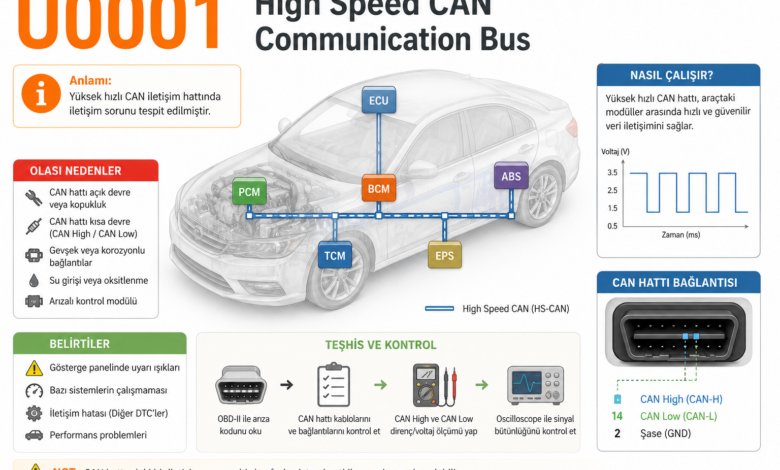
Every modern car is essentially a network of computers. The engine control module, transmission, ABS, airbags, dashboard — they all need to talk to each other constantly. The CAN bus is the highway they use to do that.
U0001 means there’s a fault on that highway. Specifically, it points to a problem with the high-speed CAN communication bus — the main network backbone that carries the most time-sensitive data between your car’s modules.
When this network goes down or starts misbehaving, the effects can show up almost anywhere. That’s what makes U0001 tricky — it’s not one system failing, it’s the communication between all of them breaking down.
What You’ll Notice
- Check engine light on, often with multiple other warning lights at the same time
- ABS, traction control, or stability control warnings
- Transmission shifting oddly or going into limp mode
- Dashboard gauges acting erratically or going blank
- Car difficult or impossible to start
- Multiple U-series codes stored alongside U0001
- Scan tool unable to communicate with one or more modules
What Usually Causes It
1. Damaged CAN bus wiring The CAN bus runs on two wires — CAN High and CAN Low — that twist together through the entire vehicle. A short between these wires, a break, or corrosion at any point along the route can take down communication across the whole network.
2. Faulty module pulling the bus down Every module connected to the CAN bus can potentially drag the whole network down if it fails in the wrong way. A shorted module creates a fault that affects every other device on the same network — even the perfectly healthy ones.
3. Weak or failing battery Low voltage is one of the most underestimated causes of CAN bus faults. The network needs stable power to maintain communication. A marginal battery can cause intermittent U0001 codes that come and go with no obvious pattern.
4. Corroded or loose connectors The CAN bus passes through dozens of connectors across the vehicle. Any one of them can introduce resistance or break the signal entirely. Connectors near the engine bay or undercarriage are particularly vulnerable to corrosion.
5. Missing or incorrect termination resistors The CAN bus requires a 120-ohm termination resistor at each end of the network to function correctly. If one of these resistors fails or is missing, signal reflections disrupt communication across the entire bus.
6. Aftermarket electronics An alarm system, aftermarket radio, or any device tapped into the CAN bus incorrectly can inject noise or interfere with signals. If U0001 appeared after any electrical work, start there.
How Serious Is U0001?
Very serious.
The CAN bus is the backbone of your car’s entire electronic system. When it’s compromised, safety systems go offline, the engine may run in a restricted failsafe mode, and in some cases the car won’t start at all. Unlike a single-system fault, U0001 can cascade across multiple modules simultaneously.
Don’t drive the car beyond what’s necessary to get it to a shop.
How to Diagnose U0001
Step 1 — Read every stored code
U0001 rarely shows up in isolation. Pull all codes from all modules and look at the full picture. Multiple U-series codes together suggest a network-wide problem. If only one or two modules are reporting communication faults, the issue may be localized to that part of the network.
Step 2 — Check the battery
Before anything else, test the battery. You want 12.4–12.7V at rest and 13.7–14.7V with the engine running. A weak battery causing intermittent U0001 codes is a common scenario — and a new battery is far cheaper than chasing a CAN bus fault that isn’t really there.
Step 3 — Measure the CAN bus resistance
With the ignition off and the scan tool disconnected, measure resistance between the CAN High and CAN Low wires at the OBD2 port. You should see approximately 60 ohms — that’s the two 120-ohm termination resistors in parallel. A reading significantly higher or lower than 60 ohms means the bus wiring or a termination resistor has a fault.
Step 4 — Check for a shorted module
If the resistance is very low (close to zero), a module is pulling the bus to ground. Disconnect modules one at a time and recheck resistance after each one. When the reading returns to normal, you’ve found the culprit.
Step 5 — Inspect wiring and connectors
Trace the CAN bus wiring harness and check every connector for corrosion, damage, or loose pins. Pay particular attention to connectors near heat sources, the undercarriage, or anywhere moisture could get in.
Step 6 — Check with a professional scan tool
A basic OBD2 reader may not be able to communicate with modules at all when U0001 is active. A dealer-level or professional scan tool can often provide more detail about which part of the network is causing the fault.
How to Fix U0001
Repair or replace CAN bus wiring — If damaged wires or corroded connectors are found, this is the fix. Proper automotive wire repair is essential — electrical tape alone won’t cut it on a communication network.
Replace a faulty module — If a specific module is pulling the bus down, it needs to come out. Replacement modules typically require programming before they’ll work correctly with your vehicle.
Replace the battery — If voltage is the culprit, a new battery resolves the issue. Always rule this out early.
Replace termination resistors — If the bus resistance test showed an abnormal reading and wiring checks out, one of the termination resistors may have failed. Their location varies by vehicle — some are built into modules, others are standalone components.
Remove interfering aftermarket equipment — If aftermarket electronics are causing the fault, removing or properly installing them is the fix. Not all aftermarket devices are compatible with modern CAN bus systems.
What It Might Cost
| Repair | Estimated Cost |
|---|---|
| Battery replacement | $80 – $200 |
| Wiring / connector repair | $150 – $500 |
| Termination resistor replacement | $50 – $200 |
| Module replacement + programming | $300 – $1,500+ |
| Full CAN bus diagnostic (dealer) | $100 – $200 |
Costs vary significantly by vehicle make, model, and labor rates.
Related Codes
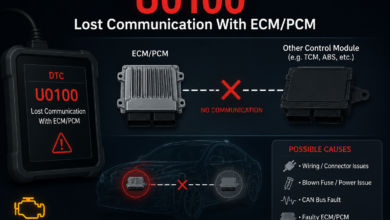
- U0100 — Lost Communication With ECM/PCM
- U0101 — Lost Communication With TCM
- U0121 — Lost Communication With ABS Control Module
- U0155 — Lost Communication With Instrument Panel
- U0073 — Control Module Communication Bus Off
Frequently Asked Questions
Can I drive with a U0001 code?
Not safely. With the CAN bus compromised, you have no guarantee that safety systems like ABS or stability control are functioning. The engine may be in a restricted failsafe mode. Drive only as far as needed to reach a workshop.
Why do so many warning lights come on at once with U0001?
Because the CAN bus connects everything. When the network goes down, modules lose contact with each other and default to displaying warnings — not because all those systems have failed, but because they can’t confirm they’re working properly.
How do I know if it’s the wiring or a failed module?
The resistance test is your first clue. If resistance is near zero, a module is likely shorted. If resistance is too high, the wiring or a termination resistor is the issue. Disconnecting modules one at a time while monitoring resistance helps isolate a shorted module.
Could the OBD2 port itself cause U0001?
Rarely, but yes. A damaged OBD2 port or a short in the pins can sometimes affect the CAN bus. If you’ve recently used a cheap aftermarket scan tool or OBD2 dongle and U0001 appeared shortly after, try disconnecting it and see if the fault clears.
Is U0001 covered under warranty?
If your vehicle is within the manufacturer’s warranty and the fault is not caused by modifications or physical damage, it should be covered. Contact your dealer before paying for any diagnosis out of pocket.
This guide is for informational purposes only. For an accurate diagnosis, always consult a qualified mechanic.