P0420: Catalyst System Efficiency Below Threshold
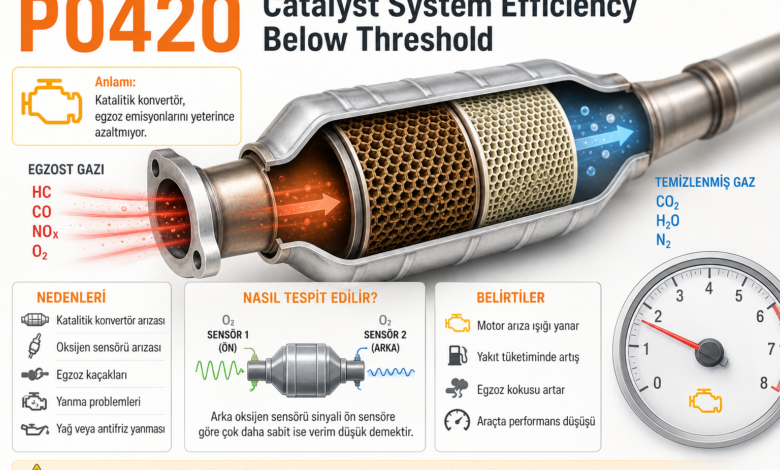
If your check engine light is on and a scanner shows P0420, your car’s computer has determined that the catalytic converter on Bank 1 isn’t cleaning exhaust gases as well as it should. This guide explains what that means, why it happens, and how to figure out whether you’re looking at a $50 fix or a $1,500 converter replacement.
What P0420 Actually Means
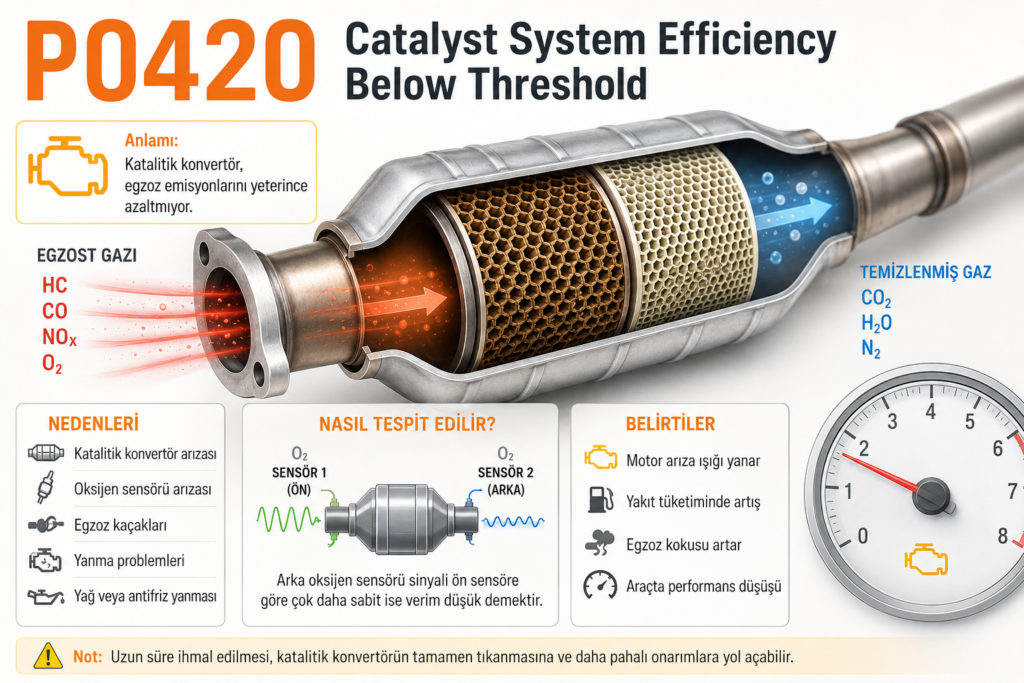
Your exhaust system has two oxygen sensors around the catalytic converter — one upstream (before it) and one downstream (after it). The upstream sensor sees a constantly fluctuating signal as the engine manages the air-fuel mixture. The downstream sensor, in a healthy system, should show a relatively steady signal — because the converter is doing its job and the exhaust coming out is clean.
When the downstream sensor starts mimicking the upstream sensor’s behavior, it tells the ECM that the converter isn’t processing exhaust properly anymore. That’s when P0420 gets logged.
“Bank 1” means the side of the engine containing cylinder #1. On a 4-cylinder, that’s the whole engine. On a V6 or V8, it’s one bank — P0430 covers the other side.
Symptoms You’ll Notice
Some cars run perfectly fine with P0420. Others don’t. Here’s what’s common:
- Check engine light — often the only symptom in early stages
- Reduced fuel economy — subtle but real as the engine compensates
- Sulfur or rotten egg smell from the exhaust — sign of a failing converter
- Sluggish acceleration — in severe cases where the converter is physically clogged
- Failed emissions test — P0420 will almost always cause a fail
If the car runs fine and fuel economy hasn’t changed, the converter may just be degraded but not yet clogged. If performance has dropped noticeably, it may be partially blocked.
Most Common Causes (In Order of Likelihood)
1. Worn-Out Catalytic Converter
Converters don’t last forever. Most last 100,000–150,000 miles under normal conditions, but they degrade faster with engine problems, oil burning, or coolant leaks into the combustion chamber. The ceramic substrate inside breaks down over time and loses its ability to process hydrocarbons, carbon monoxide, and nitrogen oxides.
How to check: Compare upstream and downstream O2 sensor waveforms on a live data scanner. If they look nearly identical, the converter isn’t working.
2. Faulty Downstream Oxygen Sensor (Bank 1, Sensor 2)
Before condemning a converter, always check the downstream O2 sensor. A sensor that’s reading incorrectly will make a perfectly good converter look bad. This is a $20–$80 fix versus a $400–$1,500 converter replacement — worth ruling out first.
How to check: Watch the downstream O2 sensor voltage on live data. It should hover steadily around 0.6–0.8V at operating temperature. If it’s oscillating rapidly like the upstream sensor, the sensor itself may be failing — or the converter is genuinely bad. A temp gun test (see below) helps distinguish the two.
3. Exhaust Leak Before the Converter
A crack or loose joint in the exhaust manifold or pipes upstream of the converter lets outside air in. That extra oxygen throws off the O2 sensor readings and can trigger P0420 even when the converter is fine.
How to find it: Listen for a ticking or hissing noise from the exhaust manifold, especially when cold. The sound often fades as the metal expands. A smoke test confirms leaks that aren’t audible.
4. Engine Misfires or Oil/Coolant Burning
Raw fuel from a misfire, or oil and coolant entering the combustion chamber, poisons the converter’s substrate. This is one of the most common ways converters fail prematurely. If you’ve had a misfire code alongside P0420, the misfire likely caused the converter damage.
Important: Replacing the converter without fixing the underlying misfire or oil burning will just kill the new converter too. Fix the root cause first.
5. Fuel System Issues
Running rich (too much fuel) for extended periods coats the converter in unburned fuel and carbon deposits, reducing efficiency. A stuck-open injector or a fuel pressure regulator problem can cause this.
6. Wrong Fuel or Fuel Contamination
Leaded fuel, certain fuel additives, or contaminated fuel can poison the converter’s precious metal catalysts (platinum, palladium, rhodium). This is less common but worth noting if the failure happened suddenly after a fill-up.
How to Diagnose It Properly
Step 1 — Check for additional codes P0420 rarely appears alone if there’s an underlying problem. Misfires (P030X), O2 sensor codes (P0136, P0141), or lean/rich codes (P0171, P0172) alongside P0420 point to a root cause that needs fixing first.
Step 2 — Live data O2 sensor comparison Connect a scanner and watch both upstream and downstream O2 sensors on Bank 1 at operating temperature. The upstream sensor should oscillate between 0.1V and 0.9V. The downstream sensor should be relatively flat. If downstream looks like upstream, the converter is failing.
Step 3 — Temperature test with an infrared thermometer A working catalytic converter runs hotter at the outlet than the inlet — because the exothermic reactions inside generate heat. Point a temp gun at the inlet pipe and outlet pipe after a 15-minute highway drive.
- Outlet significantly hotter than inlet (50°C+ difference) → converter is working
- Outlet same temperature or cooler than inlet → converter is not functioning
This is one of the most reliable low-cost tests you can do.
Step 4 — Check for exhaust leaks Inspect the exhaust manifold, flex pipe, and any joints upstream of the converter for cracks, holes, or loose clamps.
Step 5 — Check the downstream O2 sensor wiring Before replacing either the sensor or the converter, inspect the wiring harness to the downstream sensor. Corrosion, a chafed wire, or a loose connector can cause false readings.
Repair Options and Costs
| Fix | DIY Cost | Shop Cost |
|---|---|---|
| Downstream O2 sensor replacement | $20–$80 | $100–$250 |
| Exhaust leak repair (clamp/weld) | $10–$50 | $80–$200 |
| Catalytic converter (aftermarket) | $80–$300 | $300–$700 |
| Catalytic converter (OEM) | $300–$800 | $600–$1,500+ |
| Engine misfire repair (varies) | — | $100–$600+ |
A note on aftermarket converters: They’re cheaper but may not last as long and can sometimes trigger P0420 again within a year or two on certain vehicles. California and some other states also require CARB-compliant converters — check before buying.
Can You Pass Emissions With P0420?
No. In virtually every state and country that requires emissions testing, an active P0420 code will cause an automatic failure. Even if you clear the code before the test, the readiness monitors need to complete before a pass is possible — and if the converter is genuinely bad, P0420 will return quickly.
Can You Drive With P0420?
Yes, in most cases — but with caveats:
- If the car drives normally, you can drive it. The converter being inefficient doesn’t immediately damage the engine.
- If the converter is physically clogged (symptoms: very sluggish acceleration, car feels strangled at higher RPM), pull over. A blocked converter creates dangerous exhaust back pressure.
- Don’t ignore it long-term. A failing converter that’s not addressed can damage the downstream O2 sensor and cause other issues.
After the Fix
Once you’ve replaced the converter or fixed the root cause, clear the codes and drive through at least two full drive cycles before checking if P0420 returns. The ECM needs time to evaluate the new converter’s performance. Some vehicles take up to 50–100 miles of mixed driving before the readiness monitor completes.
If P0420 returns within a few hundred miles of a new converter, the underlying cause wasn’t fixed — check for misfires, oil burning, or exhaust leaks again.
Quick Reference
| Situation | Most Likely Cause |
|---|---|
| P0420 only, car runs fine | Aging converter or failing downstream O2 sensor |
| P0420 + misfire codes | Misfire damaged the converter |
| P0420 + rich/lean codes | Fuel system issue affecting converter |
| P0420 after high mileage (150k+) | Normal converter wear |
| P0420 on a recent converter replacement | Root cause not fixed, or cheap aftermarket converter |
| Rotten egg smell | Converter actively failing |
| Sluggish at high RPM | Converter may be physically clogged |
Always verify repairs with live O2 sensor data before and after. Clearing the code without fixing the root cause just delays the diagnosis — and on some vehicles, a failing converter can damage other components over time.