B1000: ECU Internal Failure
Category: Body Codes
System: Engine Control Unit (ECU)
Severity: High — the car’s brain has a problem
What Is the B1000 Code?
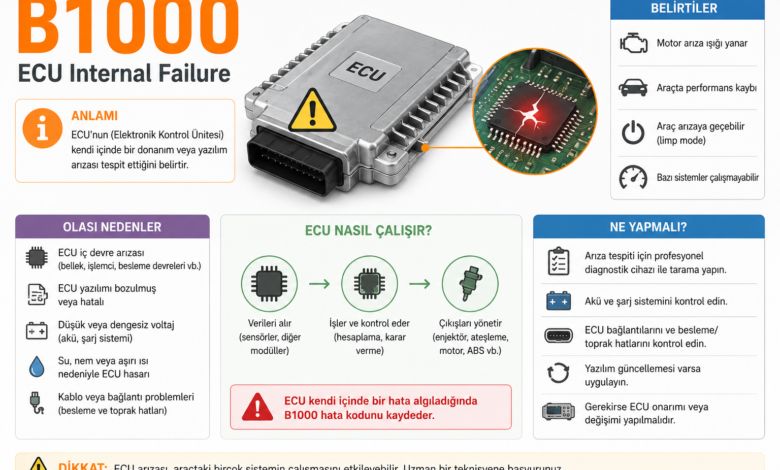
The ECU is the computer that runs your car. It reads data from dozens of sensors every second and makes constant decisions — how much fuel to inject, when to fire the spark plugs, how to manage the transmission. Everything goes through it.
B1000 means the ECU itself has reported an internal fault. It’s not a sensor that’s failed, or a component that’s worn out. The computer is telling you that something is wrong with the computer.
That’s why B1000 gets taken seriously. When the module responsible for running everything else starts malfunctioning, the effects can show up anywhere — and they often do.
What You’ll Notice
- Check engine light on
- Engine stalling, misfiring, or hesitating under acceleration
- Poor fuel economy with no other obvious cause
- Erratic readings from sensors like throttle position or MAF
- Multiple unrelated fault codes appearing at the same time
- Safety systems like ABS or airbags behaving unexpectedly
- Car going into limp mode
- In some cases, the car won’t start at all
The tricky thing about B1000 is that it can mimic almost any other fault. If you’re seeing a cluster of unrelated codes that don’t make sense together, B1000 is often the hidden cause behind all of them.
What Usually Causes It
1. Water or moisture intrusion The most common cause of ECU failure. Water finds its way in through a leaking windscreen, a blocked drain channel, or a damaged seal — and once moisture reaches the circuit board, corrosion sets in. It can happen slowly over months before the first symptom appears.
2. Electrical surge or voltage spike Jump-starting incorrectly, connecting a battery charger with the wrong polarity, or a failing alternator pushing too much voltage can all fry the delicate circuitry inside the ECU. This kind of damage is usually sudden and severe.
3. Heat damage ECUs mounted in the engine bay are exposed to a lot of heat over their lifetime. Over time, solder joints crack, capacitors degrade, and components that were fine at the factory start to fail. It’s more common on high-mileage vehicles.
4. Software corruption A failed update, a disrupted reprogramming session, or in rare cases a software bug can corrupt the ECU’s firmware. The hardware may be perfectly fine — but the software telling it what to do has become unreliable.
5. Physical damage Accident damage, vibration from worn engine mounts, or even rodent damage to the wiring entering the ECU can all cause internal faults.
6. Manufacturing defect or age Some ECUs simply fail. Components have a lifespan, and on older vehicles especially, internal failure from age alone is a real possibility.
How Serious Is B1000?
Treat it as urgent.
An ECU that’s partially failing can cause unpredictable behavior across the entire vehicle. Safety systems that rely on ECU data — ABS, stability control, airbags — may not function correctly. Engine management becomes unreliable. And the longer a failing ECU runs, the more likely it is to corrupt data or cause secondary damage to connected systems.
If the car is driveable, keep journeys short and get it diagnosed quickly. If it’s not starting or behaving dangerously, don’t drive it.
How to Diagnose B1000
Step 1 — Pull all stored codes
B1000 rarely shows up alone. Read every code from every module. A long list of unrelated codes across multiple systems is a strong indicator that the ECU itself is the root cause — not all those individual systems failing simultaneously.
Step 2 — Check power and ground to the ECU
Use a multimeter to confirm the ECU is receiving proper voltage and has solid ground connections. A weak or intermittent power supply can cause internal faults that look like hardware failure but aren’t.
Step 3 — Check the battery and charging system
A marginal battery or an overcharging alternator can stress the ECU’s internal components over time. Test battery voltage and alternator output before assuming the ECU has failed.
Step 4 — Inspect for water damage
Remove the ECU and inspect it carefully. Look for water stains, corrosion on the connector pins, or any sign of moisture inside the housing. Green or white residue on the circuit board is a clear sign of water damage.
Step 5 — Check for software issues
If the ECU has recently been reprogrammed or updated and the fault appeared shortly after, a software issue is likely. A dealer or specialist with the right equipment can attempt a reflash.
Step 6 — Test or replace the ECU
If everything else has been ruled out, the ECU needs to be bench-tested by a specialist or replaced. Some automotive electronics specialists can repair ECUs — replacing capacitors, re-soldering joints, or cleaning corrosion — at a fraction of the cost of a new unit.
How to Fix B1000
Reflash or reprogram the ECU — If it’s a software fault, this is the fix. A dealer or specialist can reload the firmware and often resolve B1000 without touching the hardware.
Repair the ECU — Specialist ECU repair shops can fix water damage, replace failed components, and restore units that would otherwise need replacing. Worth exploring before buying a new one.
Replace the ECU — If repair isn’t possible, a replacement unit is the answer. The new ECU must be programmed to your vehicle’s VIN — this is not a plug-and-play swap. An unprogrammed replacement will not work.
Fix the underlying cause — If water intrusion caused the failure, fix the leak before fitting a new ECU. If a voltage surge was responsible, check the alternator and wiring. Fitting a new ECU without addressing what killed the original one is an expensive way to learn the same lesson twice.
What It Might Cost
| Repair | Estimated Cost |
|---|---|
| ECU software reflash | $80 – $250 |
| ECU specialist repair | $150 – $500 |
| ECU replacement + programming | $500 – $1,500+ |
| Wiring / connector repair | $100 – $400 |
| Water damage remediation | $200 – $600 |
Costs vary significantly by vehicle make, model, and the extent of the damage.
Related Codes
- B0001 — Driver Airbag Deployment Control fault
- U0100 — Lost Communication With ECM/PCM
- U0001 — High Speed CAN Communication Bus fault
- P0600 — Serial Communication Link fault
- P0606 — ECM/PCM Processor fault
Frequently Asked Questions
Can I drive with a B1000 code?
It depends on how the car is behaving. If it’s running normally and only the check engine light is on, short journeys are possible — but get it diagnosed soon. If safety systems are affected, the engine is stalling, or the car is in limp mode, minimize driving until it’s fixed.
Could a bad battery cause B1000?
Indirectly, yes. A weak battery causes voltage fluctuations that can stress the ECU over time, or trigger false fault codes that look like internal ECU failures. Always test the battery before concluding the ECU itself has failed.
Is ECU repair better than replacement?
Often, yes — especially for water damage or failed capacitors. A good ECU repair specialist can fix the actual fault at significantly lower cost than a replacement unit, and you avoid the programming complexity that comes with fitting a new one.
How do I know if the ECU is actually the problem and not something else?
The pattern of fault codes is usually the biggest clue. Multiple unrelated codes across different systems, combined with B1000, strongly suggests the ECU is the source. A single B1000 with no companion codes, on the other hand, may point to a specific internal fault rather than a cascading failure.
Will a second-hand ECU work in my car?
A used ECU from the same vehicle make and model can sometimes be programmed to work in your car, but it’s not guaranteed. Many ECUs are VIN-locked and require dealer-level programming to be paired to a different vehicle. Check with a specialist before buying one.
This guide is for informational purposes only. For an accurate diagnosis, always consult a qualified mechanic.