P0338 Error Code: Symptoms, Causes, Diagnosis, and How to Fix It
1. Introduction
Every modern automobile relies on an invisible network of real-time computational data. You get behind the wheel, slide your key into the ignition, and immediately expect a flawless response from your internal combustion engine. However, beneath the surface of that smooth metal hood lies a sophisticated web of electronic monitors that coordinate thousands of mechanical actions per second. When a singular electrical breakdown occurs within this microsecond ballet, your dashboard suddenly illuminates with a bright amber check engine light. If you hook up your personal diagnostic scanner to discover the P0338 error code stored in memory, your vehicle’s engine control module (ECM) is shouting a warning that it is receiving dangerously unreadable data from its primary internal timing monitor.
The modern automotive engine is entirely dependent on absolute mathematical synchronization. For your power plant to generate clean acceleration, fuel injection pulses must match the downstroke of the piston, and the spark plug must fire at an exact micro-degree of mechanical rotation. To maintain this incredibly precise synchronization, the engine computer is dependent on the steady, uncorrupted electronic pulse generated by the crankshaft position monitor. When this underlying signal suddenly spikes above normal electrical parameters, your car’s brain loses its tracking frame of reference. The vehicle instantly begins to stumble, sputter, or completely shut down because its core operating clock has been thrown into complete chaos.
Dealing with a prominent P0338 error code can be an incredibly nerve-wracking experience for any driver, especially since the physical symptoms can manifest as an unpredictable engine shutdown right in the middle of heavy highway traffic. Yet, taking the time to understand the electronic failure at play can prevent you from throwing money at wrong replacement components or falling prey to predatory repair shop practices. In this comprehensive technical guide, we will break down the engineering behind the P0338 error code, identify the distinct operational warning signs you will notice behind the wheel, review the root mechanical and electrical causes, and outline a professional, step-by-step troubleshooting workflow to resolve the issue for good. P0338 Error Code
2. What is the P0338 Error Code?
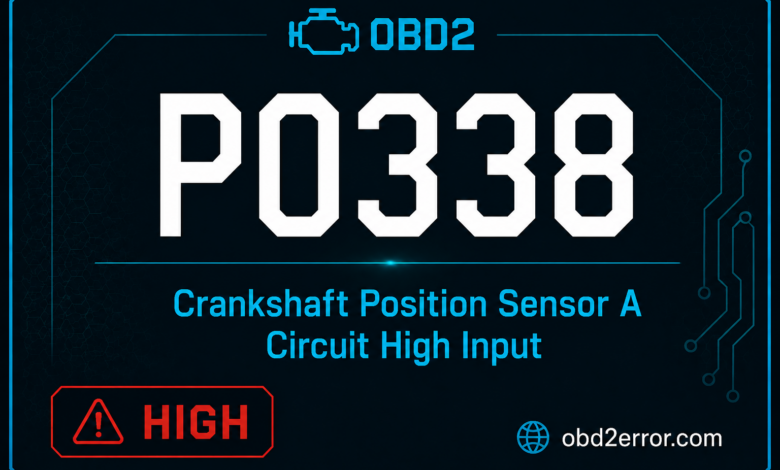
To correctly fix a recurring P0338 error code, we must first break down its formal automotive engineering definition: “Crankshaft Position (CKP) Sensor ‘A’ Circuit High Input.” Within this standardized OBD2 diagnostic protocol, the letter designation “A” indicates the primary crankshaft speed sensor or the root electrical circuit engineered to track the rotation of the lower engine block. The phrasing “High Input” is the exact diagnostic clue we must follow. It alerts the technician that the voltage level of the signal reaching the engine control module (ECM) is remaining consistently higher than the maximum safe boundary line defined by the manufacturer’s factory software engineers. P0338 Error Code
The crankshaft sensor operates as a highly sensitive electromagnetic guardian. Mounted close to a specialized reluctor ring—a metal tooth wheel attached to the spinning crankshaft—the sensor tracks each passing metal tooth as the motor turns. As the crankshaft rotates, the individual metal teeth interrupt the sensor’s internal magnetic field, creating a specific stream of voltage signals. This data stream presents as an alternating current (AC) sine wave on older variable reluctance sensors or a distinct 5-volt digital square wave on modern Hall-effect components. The central computer counts these rapid voltage fluctuations to map out engine RPM and figure out precisely when the first cylinder achieves Top Dead Center (TDC). P0338 Error Code
The distinct structural behavior of the P0338 error code sets it completely apart from other crankshaft trouble codes. For example, while a standard P0335 code indicates a basic open circuit where no electrical signal exists at all, and a companion P0337 error code marks a short to ground where the signal stays critically low, the P0338 error code points to a high-voltage overflow scenario. The computer is reading the sensor circuit, but the incoming voltage pulses are either completely saturated by a short circuit to 12-volt battery power or plagued by a massive resistance breakdown that causes the signal line to freeze at maximum voltage capacity, leaving the ECM blind to engine rotation. P0338 Error Code
3. Symptoms / What Will You Notice?
When a persistent P0338 error code takes root within your vehicle’s electronic infrastructure, the automobile will quickly exhibit noticeable drivability problems. Because the high-input voltage completely compromises the timing maps for fuel delivery and spark ignition, you can expect to notice several clear, annoying, and potentially hazardous real-world driving symptoms:
- Continuous Check Engine Light: The most immediate red flag is the warning lamp illuminating on your main instrument panel. If the high-voltage condition fluctuates with under-hood temperature spikes, this indicator might flash aggressively during operation. To better comprehend why your vehicle’s dashboard reacts this way, browsing our detailed analysis on why is my check engine light on can provide excellent context.
- Extended Cranking or Total No-Start: Because the vehicle’s engine control module requires a highly clean, reliable electrical wave signature to permit the fuel injectors and ignition coils to activate, an excessive high-input voltage error will throw off initial cranking calculations. You may experience 8 to 10 seconds of dry cranking before the motor starts, or the vehicle may refuse to fire up entirely.
- Abrupt Engine Stalling While Driving: This is easily the most severe and dangerous driving symptom caused by the P0338 error code. If the crankshaft circuit voltage spikes unexpectedly while you are maintaining cruising speeds, the engine computer will instantly lose its physical position tracking, cutting all fuel enjection as a safety override and causing the car to die instantly.
- Severe Acceleration Hesitation and Jerking: If the signal is partially readable but constantly clipping at high voltage thresholds, your timing curves will bounce around wildly. This results in rough combustion cycles, which the driver experiences as a heavy flat spot or jerking motion when stepping on the gas. If you feel this happening, researching the mechanics of engine hesitation when accelerating can shed more light on the problem.
- Rough, Jerking Engine Idle: When idling at a stop sign, you will likely feel the car shaking uncomfortably. The RPM needle will jump up and down because the computer cannot settle on a steady idle strategy without a solid speed input. This intense shaking might feel like general body vibration, but checking car shaking while driving causes fix can help you differentiate engine shaking from suspension issues.
- Drastic Drop in Fuel Efficiency: When ignition timing maps are distorted by high voltage feedback, fuel is sprayed blindly into the cylinders. This leads to incomplete combustion where unburnt gasoline gets pushed directly out into the exhaust piping, wasting fuel and accelerating secondary sensor breakdowns.
4. Common Causes
Because the P0338 error code is specifically categorized as an electrical high-input circuit failure, it rarely means a simple mechanical component breakdown. Instead, it points to a scenario where unwanted, excessive voltage has leaked into the data line or where a severe loss of ground has caused voltage to pile up inside the circuit. The most frequent causes include:
- Signal Wire Shorted to Power (12V Battery Line): The absolute leading cause behind a P0338 error code is a physical melt or breach inside the engine wiring harness. If the protective plastic loom degrades over time, the delicate sensor signal wire can physically touch an adjacent 12-volt hot wire (such as an alternator power feed or an injector wire), flooding the data line with maximum battery voltage.
- Internal Component Failure of the Crankshaft Sensor: The micro-circuitry inside a modern Hall-effect crankshaft sensor can crack or short-circuit when subjected to years of intense engine heat and continuous vibration. This internal short can bridge the input power line directly to the output signal pin, forcing a permanent high-voltage state.
- Loss of the Sensor Circuit Ground Connection: If the main ground wire or ground terminal eyelet connecting the sensor harness to the vehicle chassis becomes loose, heavily rusted, or broken, the electrical current cannot complete its loop. This lack of an exit path causes the voltage inside the circuit to rise to maximum level, triggering a high-input fault.
- Corroded, Oil-Contaminated Connector Plugs: Positioned close to the pavement and the lower engine block, the crankshaft plug is exposed to severe environmental abuse. If a valve cover leak pours motor oil into the plug, or if road salt rusts the terminals, a high-resistance path can form across the pins, causing voltage signals to back up and clip at excessive thresholds.
- Use of an Incorrect, Cheap Aftermarket Sensor: Many budget-tier aftermarket components do not match strict factory electrical resistance specs. If a replacement sensor resistance is too high or incorrectly manufactured, it can output a voltage spike that the sensitive ECM marks as a permanent P0338 error code.
- Severe Mechanical Wear of Internal Timing Components: If your timing chain tensioners collapse or the timing chain stretches excessively, the relationship between the crank and cam shafts falls out of sync. This massive physical shift can cause the computer to misread sensor frequency timings as a high-input anomaly, occasionally accompanied by a global engine misfiring symptoms causes solutions code.
- Defective Engine Control Module Hardware Pin: On rare occasions, the internal pull-up resistor or input processing chip inside the engine computer burns out. When this happens, the ECM will permanently read a high voltage input on the crankshaft monitor channel even if the wiring harness and sensor on the engine are working perfectly.
5. How Serious Is It?
The P0338 error code carries an extremely high severity classification and demands immediate professional or personal mechanical diagnostics. This is not an informational trouble code that you should choose to ignore while continuing to drive your car to work every day. The single most alarming concern with a high-input crankshaft circuit condition is the complete loss of engine reliability. Having your car stall out without warning while crossing a high-speed highway or navigating a tight turn puts you and everyone around you in immediate danger. When an engine stalls unexpectedly while the car is rolling, you instantly lose your steering pump assist and deplete your brake booster’s vacuum reservoir, leaving you with a heavy, difficult-to-stop vehicle.
From a long-term mechanical survival standpoint, operating a powertrain plagued by an unstable or over-voltage crankshaft signal can quickly destroy your motor. When the exact timing of spark ignition is distorted by a P0338 error code, the spark plugs can fire too early in the combustion loop. This triggers severe engine knocking (pre-ignition) that creates localized thermal spikes, which can melt piston domes, shatter compression rings, or score cylinder walls.
Additionally, the heavy amounts of unburnt fuel exiting the exhaust valves will travel directly down into your emissions hardware. This concentrated fuel will light up inside the catalyst brick, causing the internal precious metals to superheat and melt together. What starts as a simple, affordable wire repair can quickly morph into a devastating chain reaction that forces you to replace your entire exhaust setup due to a secondary P0420 arıza kodu failure, or buy a brand-new crate engine.
6. How to Diagnose?
Properly troubleshooting a P0338 error code requires a structured electrical verification approach. Because this code explicitly calls out a high-input voltage state, simply throwing a new sensor at the engine without checking wire health will often leave you with the exact same error code. Follow this professional step-by-step diagnostic workflow:
Step 1: Extract Diagnostic Codes and Analyze Real-Time Engine Data
Plug a professional OBD2 scan tool into the diagnostic port beneath your driver-side dashboard. Scan the system and write down all active, pending, or historical fault codes. Check if the P0338 error code is showing up alongside random ignition failure codes like the P0300 random error. Pull up the live data screen and monitor the calculated engine RPM stream while cranking the car. If the scanner shows 0 RPM or an impossible, erratic spikes like 8,000 RPM while cranking, you have confirmed a live circuit tracking issue.
Step 2: Conduct an Intensive Visual Inspection of the Wire Harness
Safely elevate the car using a professional lift or heavy-duty jack stands. Locate the physical crankshaft position sensor near the lower flywheel ring gear or front engine harmonic balancer. Meticulously inspect the wiring harness leading away from the sensor plug. Look closely for spots where the harness may have unclipped and dropped against hot exhaust pipes, or where the outer plastic loom has worn through against a sharp engine block bracket, potentially exposing bare copper wires.
Step 3: Inspect the Electrical Plug for Contamination
Unsnap the plastic wiring connector plug from the crankshaft sensor body. Peer inside both ends of the electrical plug using a high-powered flashlight. Look for standing engine oil, water droplets, or bright green terminal corrosion. If you spot oil contamination inside the connector, it means an engine oil leak is shorting the connection pins together, forcing a high voltage bridge across the signal circuit.
Step 4: Test the Harness Circuit Voltages with a Multimeter
Set your digital multimeter to the DC Volts setting to determine if external voltage is leaking into the signal line.
- Reference Power Test: Turn the vehicle ignition switch to the “ON” position but keep the engine off. Back-probe the power supply wire at the harness connector. It should read a rock-solid 5-volt or 12-volt reference signal from the ECM.
- Signal Line Over-Voltage Test: Disconnect the plug from the sensor entirely. Measure the voltage on the signal wire at the harness side with the ignition still on. If your meter reads a full 12 volts on a system designed for a 5-volt signal, you have found a definite short-to-power path in your wiring harness, confirming the root cause of the P0338 error code.
Step 5: Verify the Integrity of the Sensor Ground Circuit
Switch your digital multimeter over to the Resistance/Ohms setting. Place one probe on the ground wire inside the disconnected sensor harness plug and touch the other probe to a solid, bare metal spot on the vehicle frame or negative battery post. The display should read below 0.5 Ohms. If the meter displays an “OL” (Open Loop) message or a high resistance number, your ground wire has snapped or rusted off its ground point, which forces the circuit voltage to float up to a high-input state.
Step 6: Use an Oscilloscope to Check Live Signal Behavior
For a final, definitive test of a P0338 error code condition, tap an automotive oscilloscope into the sensor signal wire while a helper cranks or idles the vehicle. A normally functioning Hall-effect sensor must produce a clear, crisp square wave that drops cleanly down to 0 volts and rises sharply to its 5-volt peak. If the wave pattern stays permanently flatlined at maximum voltage or features clipping peaks that stretch well above normal parameters, the sensor’s internal transistors are completely blown out and require immediate replacement.
7. How to Fix It?
Once your step-by-step electrical testing has pinpointed the exact location of the voltage leakage or circuit bottleneck, you can perform the appropriate mechanical fix to banish the P0338 error code for good:
- Replacing a Blown Crankshaft Position Sensor: If your multimeter and scope analysis confirm that the sensor is internally shorted and forcing its reference voltage directly onto the signal output pin, the component must be replaced. Always spend the extra money to buy an original factory OEM replacement part. Avoid unbranded internet components, as their poor resistance specs can cause the P0338 error code to reappear the moment the car gets up to full running temperature.
- Splicing and Repairing Shorted Wire Leads: If you found a spot where the signal wire was melted against an exhaust pipe or stripped bare against a metal bracket, cut out the damaged section of wire. Strip the ends back, solder a new length of high-grade automotive wire into place, and seal the repair using adhesive-lined heat-shrink tubing to create a permanent, waterproof barrier. Never use cheap electrical tape on sensitive data lines.
- Cleaning or Replacing a Ruined Connector Plug: If the wiring connector is flooded with leaking oil or ruined by green corrosion, spray the plastic housing thoroughly with a heavy-duty electronic cleaner and wipe the pins down. If the plastic locking clip has snapped off or the pins are loose, cut the defective pigtail plug off and splice a fresh replacement harness connector into place.
- Restoring a Broken or Oxidized Ground Wire Connection: If your diagnostics revealed a missing ground path, trace the ground wire back to its physical eyelet on the frame or engine block. Remove the retaining bolt, clean away all surface rust and paint using a wire wire brush until you see shiny bare metal, reinstall the eyelet, and torque the bolt down securely to restore a clean, low-resistance ground path.
- Fixing Collapsed Timing Components: If a worn timing chain or failed hydraulic tensioner has created physical timing lag that tricks the ECM into setting a P0338 error code, you must install a complete new timing kit (including a new chain, guides, sprockets, and tensioners) and manually re-align the engine to its proper mechanical factory timing marks.
- Clearing Engine Codes and Performing a Verification Drive: Once all physical repairs are complete, plug your OBD2 scanner back in and manually erase the stored P0338 error code from the computer’s memory bank. Start the engine and let it idle for 10 minutes, then take the car out for a thorough 25-minute test drive that combines stop-and-go city streets with high-speed highway driving to ensure the check engine light stays completely dark.
8. Repair Cost
The final out-of-pocket cost to repair a P0338 error code depends heavily on whether your high-voltage problem is being caused by a simple wiring short, a dead sensor housing, or a major mechanical failure inside the engine timing cover. To help you budget for the repair, here is an itemized breakdown of average parts and labor costs across the automotive service industry:
| Repair Procedure / Part Replacement | Estimated Parts Cost | Estimated Labor Cost | Total Estimated Cost Range |
| Electrical Connector Cleaning & Pigtail Splice | $15 – $45 | $90 – $180 | $105 – $225 |
| OEM Crankshaft Position Sensor Replacement | $70 – $195 | $85 – $240 | $155 – $435 |
| Wire Harness Repair & Ground Restoration | $10 – $25 | $130 – $320 | $140 – $345 |
| Engine Oil Leak Repair & Sensor Cleanup | $25 – $80 | $120 – $280 | $145 – $360 |
| Timing Chain Kit & Tensioner Replacement | $280 – $700 | $500 – $1,200 | $780 – $1,900 |
Note: The repair projections listed above are general industry baselines. Final pricing can vary depending on your regional shop labor rates, the specific manufacturer of your vehicle, and the type of replacement parts selected.
9. Related Issues
An intense electrical circuit issue like the P0338 error code rarely happens without disrupting surrounding onboard networks. Because the crankshaft signal is the master synchronization source for the entire car, a high-input failure will often set off a string of secondary diagnostic codes and operational malfunctions across multiple systems.
For instance, when the engine control module receives clipped or constant high-voltage feedback, it cannot determine which cylinder is ready for ignition. This directly leads to major combustion dropouts, which often cause the vehicle to log a P0300 random trouble code, or set targeted cylinder tracking codes like a P0301 code or a P0302 code configuration.
Furthermore, a continuous high-input voltage error can severely disrupt how your car’s computer manages its electronic fuel injection balance. If the fuel injectors begin firing out of sequence, the fuel-to-air balance will instantly skew, forcing the vehicle to register a P0171 lean system error code because there is too much unmetered oxygen left in the cylinders.
Over a long enough timeline, forcing a vehicle to run with these severe timing and fuel delivery errors will cause extensive thermal breakdown down your exhaust system. The raw, unburnt gasoline escaping into your exhaust manifold will ignite directly inside your catalytic converter, causing the inner ceramic brick to overheat and collapse, which will eventually force you to deal with an expensive P0420 catalyst efficiency code repair bill.
10. Frequently Asked Questions
Can I drive my vehicle safely while a P0338 error code is active?
No, you should never drive a vehicle with a live P0338 error code. Because this code means the crankshaft circuit voltage is dangerously high and near maximum limits, the signal can drop out completely without warning. If this happens while you are driving at high speeds, the engine will instantly shut off, causing you to lose your power steering and power brakes in heavy traffic.
What is the core difference between the P0337 and P0338 trouble codes?
The primary difference is the electrical state of the circuit. The P0337 error code means the circuit voltage is staying critically low, which is usually caused by a signal wire that is pinched directly against a metal chassis ground. The P0338 error code means the circuit voltage is trapped at an excessively high level, which is typically caused by a signal wire shorted to a 12-volt battery power source or a complete loss of the ground connection.
Can an oil leak cause a P0338 error code to trigger?
Yes, a severe engine oil leak from a valve cover gasket or a front main crankshaft seal can directly trigger a P0338 error code. If engine oil creeps past the plastic seals of the sensor connector plug, the oil can create a bridge between the 12-volt power pin and the signal return pin, flooding the circuit with high voltage.
Why does my engine crank for a very long time before starting when this code is present?
When you turn the key, the ECM looks for a clean voltage pulse from the crankshaft sensor to know when to fire the spark plugs. Because the P0338 error code means the circuit voltage is frozen at a high level, the computer cannot see the engine turn. It will crank for a long time until it enters a backup operating mode that uses the camshaft position sensor to guess when to start the engine.
Can a bad alternator trigger a P0338 error code?
Yes, a failing alternator with a blown internal diode can cause a P0338 error code to appear. If an alternator diode fails, it can leak raw alternating current (AC) voltage ripples directly into the vehicle’s electrical system, which can create massive electrical noise and voltage spikes that override the delicate crankshaft sensor circuit.
Will clearing the code with an OBD2 scanner permanently fix the issue?
No, simply erasing the code with an OBD2 scan tool will not fix a P0338 error code. Because this code is triggered by a real physical problem—such as melted wire insulation, a missing ground connection, or a shorted internal component—the engine computer will immediately flag the high-input voltage and trigger the check engine light again during your next drive cycle.
Does a P0338 error code mean my engine timing chain has broken?
Not necessarily. While a severely stretched timing chain can cause sensor sync errors, a broken timing chain would result in zero engine rotation data and a total mechanical engine failure. The P0338 error code is almost always a strict electrical circuit issue, meaning you are dealing with a wire shorted to power, a bad sensor, or a corroded electrical connector.