P0328 Code: Knock Sensor 1 Circuit High Input Bank 1
The P0328 code means your engine control module is receiving a signal from the knock sensor 1 circuit on bank 1, but that signal is higher than the maximum expected threshold. Where the P0327 code flags a signal that’s too low, the P0328 code flags the opposite — the voltage coming from the knock sensor circuit is too high for the ECM to trust.
When the P0328 code is stored, the ECM sees a knock sensor signal that looks like the engine is constantly, severely knocking — or that a fault in the circuit is producing an artificially elevated voltage. Either way, the ECM can’t use the data reliably. Its response is to default to a conservative ignition timing map that protects the engine but reduces power and fuel efficiency.
The P0328 code is less common than the P0325 code or P0327 code, but it’s equally important to diagnose correctly. A high signal fault has a different set of causes than a low signal fault, and understanding what drives the signal high is the key to fixing P0328 efficiently.
What You’ll Notice
- Check engine light on
- Noticeably reduced engine power, especially under load
- Worse fuel economy than usual
- Engine feels sluggish and unresponsive during acceleration
- The ECM may be retarding timing aggressively, causing the engine to run cooler than normal
- Possible rough running if the timing retard is severe
- Unlike the P0327 code, pinging under acceleration is less common with P0328 — the ECM is already retarding timing heavily in response to the high signal
The P0328 code produces symptoms that look a lot like other timing-related faults. The key distinguishing feature is that the power loss and sluggishness appear across all driving conditions — not just under hard acceleration — because the ECM is permanently in maximum timing retard mode in response to the elevated knock sensor signal.
Bank 1 — Which Side?
Bank 1 is the side of the engine containing cylinder 1. On most vehicles this is the driver’s side, but always confirm in your vehicle’s service manual. On inline engines there’s only one bank, so the P0328 code refers to the only knock sensor or the first of two sensors on that engine.
What Usually Causes the P0328 Code
1. Short to voltage (short to power) in the signal wire The most common electrical cause of the P0328 code. A wire that has shorted to a 5V or 12V source in the wiring harness feeds an artificially high voltage into the knock sensor signal circuit. The ECM reads this elevated voltage as a knock signal far beyond normal parameters and stores the P0328 code. This type of fault is particularly common where the knock sensor wiring harness runs close to other wiring circuits — if the insulation wears through in the right spot, a short to power results.
2. Faulty knock sensor producing excessive output A knock sensor whose internal piezoelectric element has failed in a way that causes it to generate excessive voltage — rather than the more common low output failure — can trigger the P0328 code. This type of sensor failure is less common than the degraded output that causes the P0327 code, but it does occur. On engines that have experienced significant overheating or severe detonation events, the piezoelectric element can be physically damaged in ways that alter its output characteristics unpredictably.
3. Excessive engine mechanical noise This is one of the most important causes of the P0328 code to understand — and one that doesn’t involve a faulty sensor at all. If the engine has significant mechanical noise from worn bearings, a loose or stretched timing chain, worn piston rings, or failing accessory drive components, the knock sensor picks up all of that vibration. When the vibration level is severe enough, the signal amplitude exceeds the ECM’s upper threshold and the P0328 code is stored. In this scenario, the knock sensor is working perfectly — it’s just reporting accurately that the engine has a serious mechanical problem.
4. Resonance from a loose or damaged heat shield Exhaust heat shields, engine covers, and similar components that have come loose rattle and resonate at frequencies that the knock sensor picks up. Depending on the resonance frequency and amplitude, this external noise source can drive the knock sensor signal above the normal threshold and trigger the P0328 code — particularly at certain RPMs where the resonance frequency matches the sensor’s detection range.
5. Incorrect replacement sensor If the P0328 code appeared after a knock sensor replacement, the new sensor may be the wrong specification for the application. Different engines use sensors tuned to different frequency ranges. A sensor designed for a different application can produce an output that’s in the wrong voltage range for the ECM, triggering the P0328 code even though the sensor itself is functional. Always verify the part number matches the original exactly before installation.
6. Contamination of the sensor or sensor mount area Oil or coolant contamination in the area around the knock sensor can affect how vibration is transmitted to the sensor. In some cases, contamination causes the sensor to over-respond to vibration rather than under-respond — potentially contributing to the elevated signal that triggers the P0328 code. This is more of a contributing factor than a standalone cause, but it’s worth checking for when investigating P0328.
7. Wiring harness routing issue A knock sensor wiring harness that has been rerouted incorrectly — or that has shifted out of its correct routing due to missing or damaged harness clips — can run too close to high-voltage ignition wiring or other interference sources. The electromagnetic interference from ignition coil wiring can induce voltage in the knock sensor signal wire, elevating the signal and triggering the P0328 code.
How Serious Is the P0328 Code?
The P0328 code is serious for two distinct reasons, and understanding both matters.
First, like all knock sensor codes, the P0328 code means the knock control system isn’t providing reliable protection. The ECM is responding to an artificially high signal by retarding timing — which protects the engine from the theoretical knock the signal implies — but it’s not responding to actual knock events intelligently. If real knock occurs for a reason the elevated signal doesn’t account for, the response may not be appropriate.
Second, and more urgently, if the P0328 code is being caused by excessive engine mechanical noise rather than an electrical fault, the engine has a serious internal problem that needs immediate attention. A worn bearing, a stretched timing chain, or severe piston ring wear are not problems to ignore. The P0328 code in this context isn’t a sensor problem — it’s the sensor correctly reporting that the engine is in distress.
Always rule out engine mechanical causes before assuming the P0328 code is purely an electrical fault.
How to Diagnose the P0328 Code
Step 1 — Read all stored codes and freeze frame data
Confirm the P0328 code and look for companion codes. The P0324 code alongside P0328 indicates a system-level issue. P0325 or P0326 alongside P0328 suggests the sensor circuit has multiple fault conditions. Mechanical noise codes or engine performance codes stored alongside P0328 are a strong signal to check engine mechanical condition before touching the knock sensor system.
Step 2 — Listen to the engine carefully
Before touching any electrical components, start the engine and listen. Use a mechanic’s stethoscope to check for unusual mechanical sounds — bearing knock, timing chain rattle, accessory drive noise. Also listen for any rattling heat shields or loose covers that could be generating external vibration. If the engine sounds rough, unhealthy, or noticeably noisier than normal, the P0328 code may be the sensor accurately reporting a mechanical problem rather than an electrical fault.
Step 3 — Check for a short to voltage
With the sensor disconnected, use a multimeter to measure voltage between the signal wire and ground with the ignition on. There should be a reference voltage or no voltage depending on the sensor type — but there should not be battery voltage (12V) on the signal wire. If you measure 12V on the signal wire with the sensor disconnected, the signal wire has shorted to a power source somewhere in the harness. This is a wiring repair job.
Step 4 — Inspect the sensor and connector
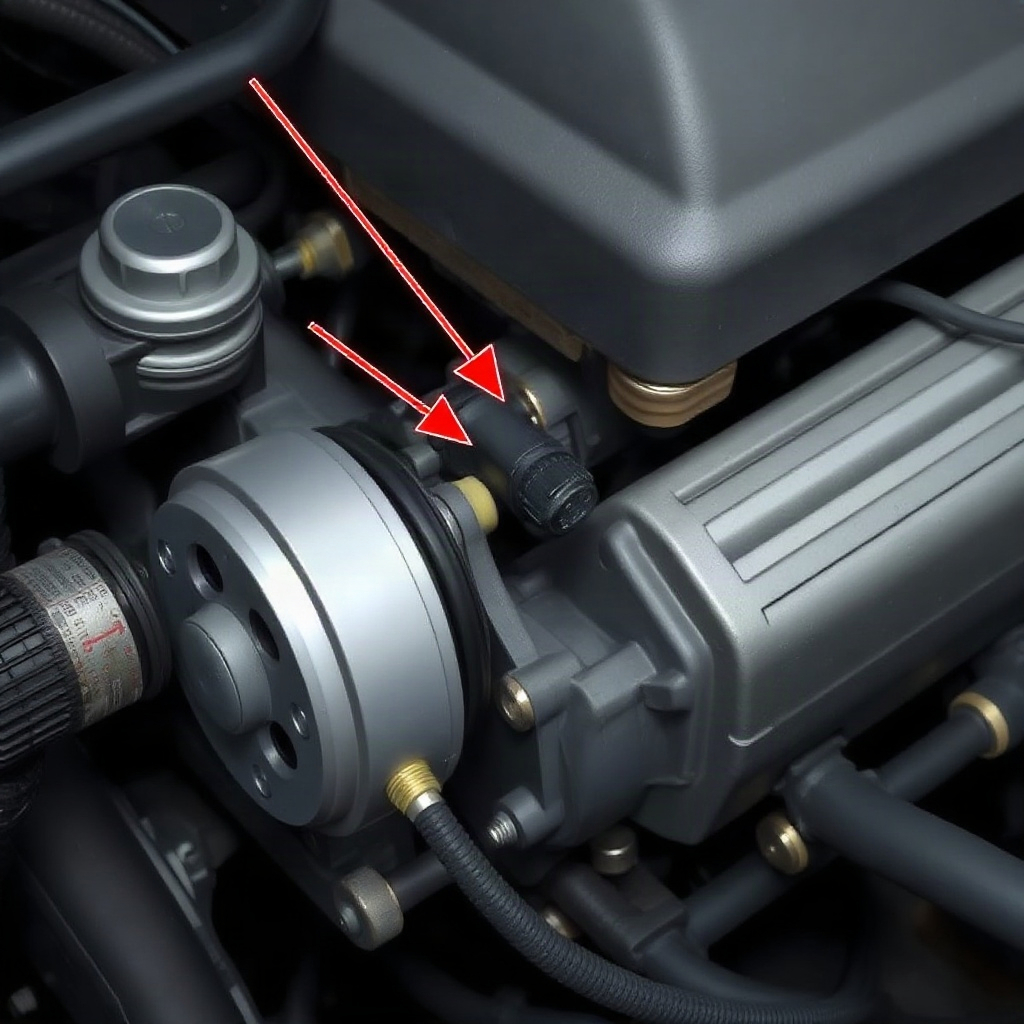
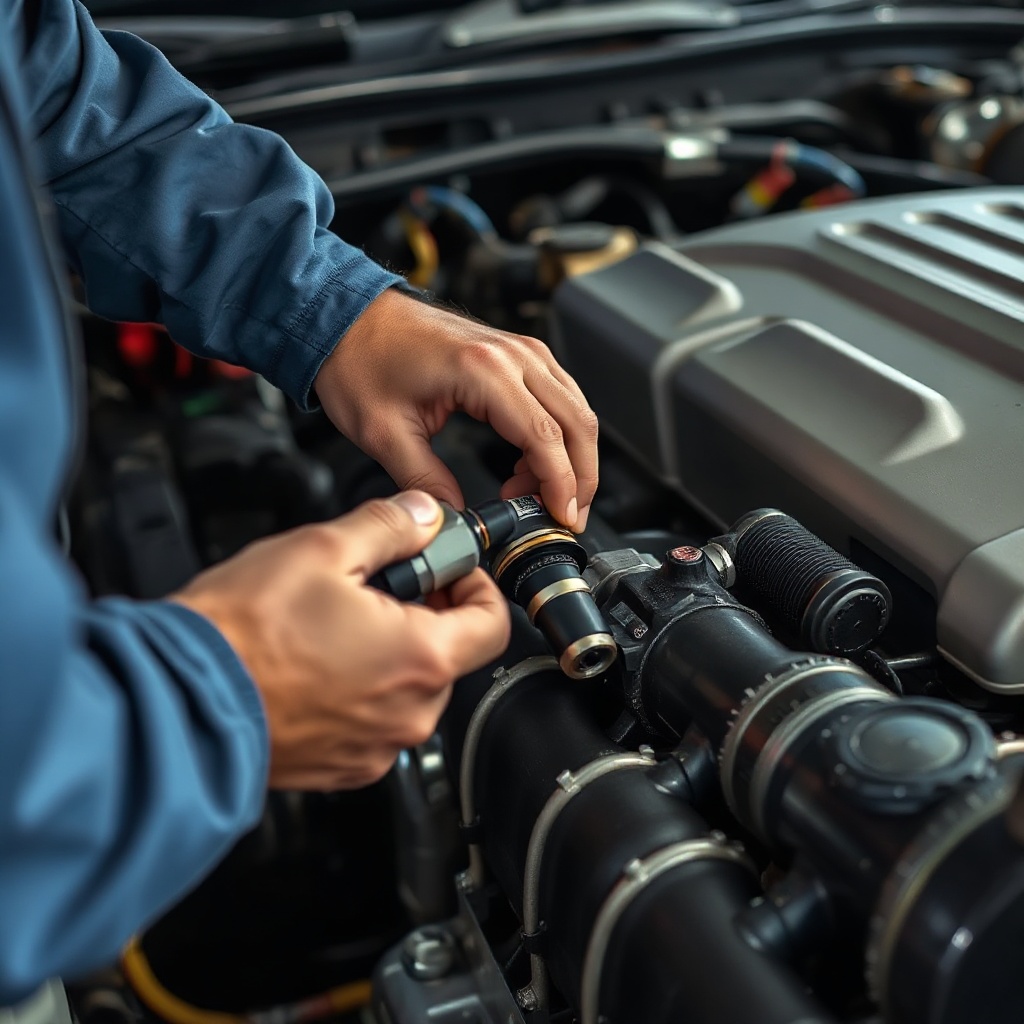
Inspect the knock sensor body for damage and the connector for corrosion, bent pins, and secure engagement. Check the wiring harness routing — confirm it’s following the original factory path and isn’t running too close to ignition wiring. Look for any evidence of oil or coolant contamination around the sensor mount.
Step 5 — Test the sensor signal with live data
Connect a scan tool capable of graphing knock sensor voltage and monitor the signal at idle. The P0328 code is associated with a signal that’s consistently elevated. A healthy knock sensor at idle should show a low, relatively quiet signal with occasional small spikes. A signal that’s consistently near the top of the range or that spikes wildly without corresponding to obvious vibration events confirms the P0328 code diagnosis.
Step 6 — Oscilloscope test
An oscilloscope connected to the knock sensor signal wire gives you the most detailed view of what’s causing the P0328 code. An elevated baseline signal that never drops to normal levels points to a short to voltage. Wild, random spikes suggest interference from a nearby wiring source. Large, structured spikes at regular intervals suggest mechanical noise is the cause. The oscilloscope waveform tells you exactly what kind of high signal you’re dealing with.
Step 7 — Check the alternator
A failing alternator can produce voltage spikes on the electrical system that induce elevated voltage on the knock sensor circuit, contributing to the P0328 code. Test alternator output with a multimeter — measure AC voltage across the battery with the engine running. More than 0.5V AC indicates a failing alternator diode.
Step 8 — Check for loose heat shields and covers
With the engine running, gently push on any heat shields, engine covers, or other loose-fitting components near the knock sensor. If the knock sensor signal changes when you stabilize a vibrating component, that component is generating the noise that’s triggering the P0328 code. Tighten or replace the offending component.
How to Fix the P0328 Code
Repair the short to voltage — If a signal wire short to power was found, locate the damaged section of harness and repair it. Inspect the full harness routing carefully for other areas where insulation wear could cause future problems. Verify the short is fully resolved before starting the engine with a new sensor.
Replace the knock sensor — If the sensor itself is producing an elevated output and no wiring fault was found, replace it. Verify the replacement part number matches the original exactly — using the wrong sensor type is a common cause of P0328 returning after replacement.
Fix the engine mechanical issue — If excessive engine noise is causing the P0328 code, the mechanical problem must be addressed. A worn timing chain needs replacement. Worn bearings are a more significant repair. Loose heat shields need tightening or replacement. Fixing the noise source resolves the P0328 code without touching the knock sensor.
Repair wiring harness routing — If the harness is running too close to ignition wiring and picking up interference, reroute it correctly and secure it with proper clips. This is a free fix if the harness itself isn’t damaged.
Replace the alternator — If AC ripple from the alternator is contributing to the P0328 code, replace the alternator. Resolve this before investing in knock sensor components.
P0328 on Specific Vehicle Makes
Toyota and Lexus V6 engines (1MZ-FE, 2GR-FE): The P0328 code on Toyota V6 engines is less common than P0325 or P0327, but when it does appear it’s often related to wiring harness shorts that develop in the under-intake routing. The same heat-degraded harness that causes low signal faults can also develop short-to-voltage conditions as insulation breaks down between wires. Toyota’s updated harness kit addresses this.
Nissan VQ V6 (Altima, Maxima, 350Z, 370Z): P0328 on VQ engines follows similar patterns to Toyota — harness degradation under the intake manifold can produce various signal faults including high input conditions. Mechanical noise from timing chain stretch on high-mileage VQ engines can also trigger the P0328 code.
GM LS-series engines (Silverado, Tahoe, Camaro): On high-mileage LS engines, the P0328 code occasionally appears in conjunction with timing chain noise. The LS timing chain system can develop stretch and rattle at very high mileage, and the knock sensors pick up this noise. Check the timing system carefully before replacing sensors on high-mileage LS engines with P0328.
Honda engines: The P0328 code on Honda engines is relatively uncommon. When it does appear, it’s most often related to a sensor producing an elevated output or a minor wiring issue near the sensor connector. Honda knock sensors are externally accessible and straightforward to replace.
BMW inline 6 and V8: On BMW engines with separate knock control modules, the P0328 code can sometimes originate in the module rather than the sensor or wiring. A module fault that reports an elevated signal to the ECM produces P0328 without any physical fault in the sensor circuit.
What It Might Cost to Fix the P0328 Code
| Repair | Estimated Cost |
|---|---|
| Heat shield tightening (DIY) | Free |
| Wiring short repair | $100 – $400 |
| Knock sensor replacement (accessible) | $80 – $250 |
| Knock sensor replacement (under intake) | $300 – $700 |
| Toyota/Nissan updated harness kit + labor | $400 – $800 |
| Timing chain replacement | $600 – $1,500 |
| Alternator replacement | $200 – $600 |
| Engine bearing repair | $1,000 – $3,000+ |
Costs vary significantly by vehicle. The most expensive scenario is when the P0328 code is caused by internal engine mechanical problems rather than an electrical fault.
Related Codes
- P0324 — Knock Control System Error
- P0325 — Knock Sensor 1 Circuit Malfunction Bank 1
- P0326 — Knock Sensor 1 Circuit Range/Performance Bank 1
- P0327 — Knock Sensor 1 Circuit Low Input Bank 1
- P0330 — Knock Sensor 2 Circuit Malfunction Bank 2
- P0333 — Knock Sensor 2 Circuit High Input Bank 2
- P0300 — Random/Multiple Cylinder Misfire Detected
Frequently Asked Questions
Can I drive with the P0328 code? Short trips are possible since the ECM is already retarding timing in response to the P0328 code. But if the P0328 code is being caused by engine mechanical noise rather than an electrical fault, continuing to drive could cause serious engine damage. Listen carefully to the engine — if it sounds rough or has an unusual knocking sound, stop driving and get it properly diagnosed before going further.
What is the difference between the P0328 code and the P0327 code? The P0327 code means the knock sensor signal is too low — below the ECM’s minimum threshold. The P0328 code means the signal is too high — above the maximum threshold. P0327 is more commonly caused by sensor degradation, undertorque, or a short to ground. The P0328 code is more commonly caused by a short to voltage, excessive engine mechanical noise, or a sensor producing an elevated output.
Could a loose heat shield really cause the P0328 code? Yes, and it’s more common than people expect. A loose heat shield or engine cover that rattles at specific RPMs generates vibration in the frequency range the knock sensor monitors. If the amplitude is high enough, it drives the signal above the P0328 threshold. The fix is free — tighten or replace the loose component and clear the P0328 code.
The P0328 code appeared after I replaced the knock sensor — why? The most likely cause is an incorrect replacement part. Verify the new sensor’s part number matches the original exactly. Different sensor types produce different voltage outputs, and a sensor designed for a different application can produce an elevated signal that triggers the P0328 code. Also check whether a short to voltage exists in the signal wiring — fitting a new sensor into a shorted circuit produces the same P0328 code immediately.
Can the P0328 code indicate a serious engine problem? Yes. When the P0328 code is caused by excessive mechanical noise rather than an electrical fault, the engine has a significant internal problem. Worn bearings, severe timing chain stretch, or serious piston ring wear all generate vibration that the knock sensor picks up and reports as an elevated signal. The P0328 code in this context is the sensor doing its job correctly — and the underlying mechanical issue needs urgent attention.
How do I know if P0328 is electrical or mechanical? Listen to the engine carefully before any electrical diagnosis. If the engine sounds normal and quiet, P0328 is almost certainly electrical — a wiring fault or sensor issue. If the engine sounds rough, has a new knocking or rattling noise, or has significantly increased in overall noise level, the P0328 code is likely being caused by mechanical noise and the engine needs inspection before anything else.
For more information on OBD-II diagnostic standards and engine knock, visit the National Highway Traffic Safety Administration (NHTSA) or the SAE International standards library.
This guide is for informational purposes only. For an accurate diagnosis, always consult a qualified mechanic.