P0330 Code: Knock Sensor 2 Circuit Malfunction Bank 2
The P0330 code means your engine control module has detected a fault in the knock sensor 2 circuit on bank 2. The P0330 code is the bank 2 equivalent of the P0325 code — which covers knock sensor 1 on bank 1. Where P0325 targets the cylinder 1 side of the engine, the P0330 code targets the opposite bank.
When the P0330 code is stored, the ECM has lost confidence in the knock sensor circuit on bank 2. The sensor may have failed completely, the wiring may be damaged, or the circuit may have a short or open that prevents reliable signal transmission. Whatever the cause, the ECM can no longer use the bank 2 knock sensor data to protect that side of the engine from detonation.
The ECM’s response to the P0330 code is to default to a conservative ignition timing map across the engine — retarding timing more than necessary to be safe without reliable knock data. This protects the engine in the short term but comes at the cost of reduced power and fuel economy. Understanding the P0330 code and its causes is the first step toward getting the engine running efficiently again.
What You’ll Notice
- Check engine light on
- Reduced engine power, particularly under hard acceleration
- Worse fuel economy than usual
- Engine feels sluggish, especially at higher loads
- Possible pinging or knocking sound under heavy throttle if actual detonation goes undetected
- On some vehicles a slight reduction in throttle response
- No rough idle, no stalling — the P0330 code doesn’t stop the engine from running
The P0330 code is one of those faults that allows the car to keep running but quietly degrades performance. Because the symptoms are gradual rather than dramatic, the P0330 code is easy to put off. That’s a mistake. Without a functioning knock sensor on bank 2, that side of the engine has no detonation protection, and sustained undetected knock causes expensive internal damage over time.
Bank 2 — Which Side?
The P0330 code targets bank 2 — the side of the engine that does not contain cylinder 1. On most vehicles bank 2 is the passenger side, but this varies by manufacturer. Always confirm in your vehicle’s service manual before beginning diagnosis of the P0330 code. Getting the bank identification wrong before you start wastes time and leads to unnecessary parts replacement.
On inline engines — 4-cylinder and inline 6 — there is only one bank, so the P0330 code on these engines refers to the second of two knock sensors rather than a separate bank. If your inline engine only has one knock sensor, you won’t see the P0330 code — that code is specific to multi-sensor applications.
What Usually Causes the P0330 Code
1. Faulty knock sensor on bank 2 The most common cause of the P0330 code. The knock sensor on bank 2 has failed — either completely or in a way that produces no usable signal. Knock sensors degrade over time, particularly on high-mileage engines and on engines that have experienced overheating. When the piezoelectric element inside the sensor fails, the ECM receives no signal from bank 2 and stores the P0330 code.
2. Damaged wiring or connector on the bank 2 circuit The wiring harness connecting the bank 2 knock sensor to the ECM is exposed to heat, vibration, and road contamination throughout the engine’s life. A chafed wire, a corroded connector, or a broken terminal interrupts the signal and triggers the P0330 code. On Toyota and Nissan V6 engines especially, the knock sensor wiring for both banks runs under the intake manifold — where heat exposure over time causes insulation cracking and terminal corrosion that produces the P0330 code.
3. Loose knock sensor on bank 2 The knock sensor must be torqued to a precise specification — typically 15–20 Nm depending on the manufacturer. A sensor that’s come loose after a previous repair, or that was installed without a torque wrench, doesn’t maintain proper contact with the engine block. Without solid metal-to-metal contact, the sensor can’t detect vibration accurately, and the P0330 code is the result. This is one of the cheapest and quickest fixes when it’s the cause — always check torque before replacing any components.
4. Short circuit in the bank 2 knock sensor circuit A short to ground or short to voltage in the bank 2 knock sensor wiring disrupts the signal in ways the ECM interprets as a circuit malfunction — storing the. A short to ground pulls the signal voltage below the minimum threshold. A short to voltage pushes it above the maximum. Either condition prevents the ECM from reading valid knock data from bank 2.
5. Oil or coolant contamination near the bank 2 sensor On some engine designs, the bank 2 knock sensor is mounted in a location exposed to oil leaks or coolant seepage. Contamination of the sensor body or connector causes corrosion and signal degradation that eventually triggers the P0330 code. If you find evidence of oil or coolant near the bank 2 sensor, address the leak source before replacing the sensor — otherwise the new sensor fails the same way.
6. Electromagnetic interference A failing alternator producing AC ripple, or poorly grounded aftermarket electronics, can corrupt the knock sensor signal on bank 2 and trigger the P0330 code. EMI-induced often appear alongside other intermittent electrical faults — flickering gauges, other intermittent sensor codes, or a battery warning light.
7. ECM fault on the bank 2 knock sensor input Rare, but possible. A fault in the ECM’s processing circuit for the bank 2 knock sensor produces the P0330 code even when the sensor and wiring are completely healthy. This should only be investigated after all external causes have been systematically ruled out through proper testing.
How Serious Is the P0330 Code?
The P0330 code is serious — and the consequences of ignoring it are the same as ignoring any knock sensor fault.
The ECM’s conservative timing response to the protects the engine in the short term. But bank 2 is completely unprotected from detonation — if knock occurs on that side of the engine while the P0330 code is active, it goes undetected and uncorrected. Knock damage is cumulative and expensive. Damaged pistons, spun rod bearings, and cracked ring lands are all possible consequences of sustained undetected detonation on bank 2.
On V6 and V8 engines, the P0330 code affects half the engine — every cylinder on the bank 2 side has no knock protection while this fault is active. Fix the P0330 code promptly rather than running on conservative timing indefinitely.
How to Diagnose the P0330
Step 1 — Read all stored codes and freeze frame data
Confirm the P0330 code and look carefully for companion codes. The P0325 code alongside the P0330 code means both knock sensor circuits have faults — pointing toward a common cause like a power supply issue, a shared wiring fault, or a failing alternator rather than individual sensor failures. The P0324 code alongside P0330 indicates a system-level problem affecting the entire knock control system. Note the freeze frame data — it captures the exact conditions when the P0330 code was stored.
Step 2 — Locate the bank 2 knock sensor
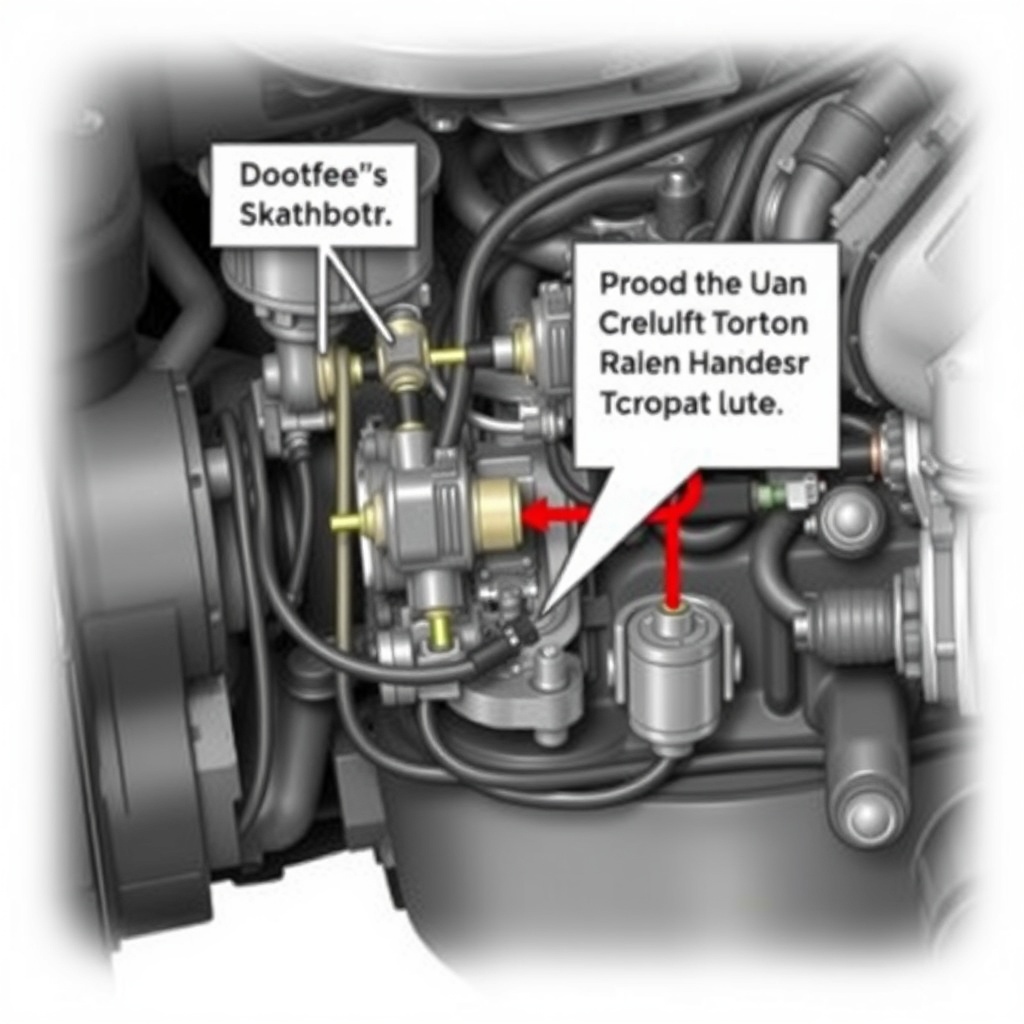
The bank 2 knock sensor location varies considerably by engine:
- Toyota V6 (1MZ-FE, 2GR-FE, 3GR-FSE): Under the intake manifold on the bank 2 side — intake removal required for access to diagnose the P0330 code on these engines
- Nissan VQ V6 (Altima, Maxima, 350Z): Under the intake manifold — same access requirements as Toyota
- GM LS V8: Between the cylinder banks on the engine block — intake manifold removal typically required
- Ford Modular V8: On the engine block, accessible with varying difficulty depending on the generation
Knowing the access requirements for bank 2 on your specific engine helps you plan the P0330 code diagnosis realistically.
Step 3 — Check sensor torque
Before any electrical testing, locate the bank 2 knock sensor and check whether it’s properly secured. A sensor that can be moved by hand is undertorqued and is a likely cause of the P0330 code. Retorque to specification using a torque wrench, clear the P0330 code, and test drive. If the code doesn’t return, undertorque was the cause — the cheapest and fastest P0330 code fix possible.
Step 4 — Inspect the sensor and connector
With the bank 2 sensor located, inspect the sensor body for cracks or damage and the connector for corrosion, moisture, and pin condition. Check for any evidence of oil or coolant contamination around the sensor mount. Clean any corrosion with electrical contact cleaner and reconnect firmly. Clear the P0330 code and retest.
Step 5 — Test for shorts in the circuit
With the bank 2 sensor disconnected, use a multimeter to check resistance between the signal wire and ground. Infinite resistance means no short to ground. Any resistance reading indicates a partial short pulling the signal down. Also check voltage on the signal wire with the ignition on — battery voltage (12V) on the signal wire indicates a short to power that must be repaired before the P0330 code can be resolved.
Step 6 — Test sensor resistance
Disconnect the bank 2 knock sensor and measure resistance across the sensor terminals. Compare to the manufacturer’s specification for your sensor type. Flat-response sensors should read infinite resistance. Traditional piezoelectric sensors typically read between 100 kΩ and 10 MΩ. A reading outside the expected range confirms the bank 2 sensor has failed and is the cause of the P0330 code.
Step 7 — Test the sensor signal
Connect an oscilloscope to the bank 2 knock sensor signal wire with the sensor connected and the engine running. Tap the engine block on the bank 2 side with a wrench handle. A functional sensor produces a clear voltage spike in response. No response confirms the bank 2 sensor is not generating a usable signal — confirming the P0330 code diagnosis at the sensor level.
Step 8 — Monitor live data
Use a scan tool capable of graphing knock sensor data to monitor the bank 2 signal in live data during a drive. Compare the bank 2 signal to the bank 1 signal — they should behave similarly under the same conditions. A bank 2 signal that stays at zero while bank 1 responds normally confirms the P0330 code is a bank 2 sensor or circuit fault rather than a system-wide issue.
Step 9 — Check the alternator
If both knock sensors are reporting faults simultaneously or the P0330 code appears alongside other intermittent sensor codes, test the alternator for AC ripple. More than 0.5V AC across the battery terminals with the engine running indicates a failing alternator diode that may be causing the P0330 code through electromagnetic interference.
How to Fix the P0330
Retorque the bank 2 knock sensor — Always check this first when diagnosing the P0330 code. A properly torqued sensor costs nothing to fix and takes minutes. Use a torque wrench — never estimate the torque on a knock sensor.
Replace the bank 2 knock sensor — If the sensor is confirmed as failed through resistance or signal testing, replace it. Use an OEM or quality aftermarket sensor — cheap knock sensors are a common cause of the returning after replacement. Verify the part number matches the original exactly.
Repair wiring and connectors — If a damaged wire, corroded connector, or short circuit is found during P0330 code diagnosis, repair it properly. Use automotive-grade wire and heat-shrink connectors. Routing the repaired harness away from heat sources prevents future P0330 code recurrence.
Replace the alternator — If AC ripple from the alternator is causing the P0330 code, a replacement alternator resolves the fault without touching the knock sensor system.
Address oil or coolant leaks — If contamination caused the bank 2 sensor to fail, fix the underlying leak source before fitting a new sensor. Installing a new sensor without addressing the contamination cause means the returns as the new sensor fails the same way.
ECM replacement or reprogramming — Only as a last resort after all other causes of the P0330 code have been confirmed as serviceable through systematic testing.
P0330 on Specific Vehicle Makes
Toyota and Lexus V6 (1MZ-FE, 2GR-FE, 3GR-FSE): The P0330 code is extremely common on these engines — just as common as P0325 on the bank 1 side. Both knock sensors are located under the intake manifold, and both sides of the wiring harness degrade together from heat exposure. Toyota sells an updated wiring harness kit that covers both banks — when fixing the P0330 code on these engines, it makes sense to replace both sensors and the full harness at the same time to prevent the bank 1 code appearing shortly after. Budget for 3–5 hours of labor.
Nissan VQ V6 (Altima, Maxima, Murano, 350Z, 370Z, Pathfinder): The P0330 code follows the same pattern as Toyota on VQ engines. Under-intake harness degradation affects both banks, and both sensors commonly fail together on high-mileage examples. Addressing both banks at the same time when fixing the P0330 code on VQ engines is strongly recommended.
GM LS and LT V8 (Silverado, Sierra, Tahoe, Camaro, Corvette): The P0330 code on LS engines is less common than on Toyota and Nissan V6 platforms but does appear on high-mileage examples. The bank 2 sensor on LS engines requires intake manifold removal for access. The sensors themselves are inexpensive — labor is the main cost when fixing the on these engines.
Ford Modular V8 (Mustang GT, F-150, Explorer): The P0330 code on Modular engines typically involves sensor failure rather than wiring issues. The bank 2 sensor is accessible with varying degrees of difficulty depending on the model year and configuration. Connector corrosion is a known contributor to the P0330 code on Ford Modular engines in high-humidity climates.
BMW V8 and inline 6 (3 Series, 5 Series, X5): On BMW engines, the P0330 code can sometimes originate in the separate knock control module rather than the sensor itself. BMW uses a dedicated knock control module on many models, and module faults produce P0330 independently of the sensor condition. Check the module before replacing sensors when diagnosing the P0330 code on BMW vehicles.
What It Might Cost to Fix the P0330 Code
| Repair | Estimated Cost |
|---|---|
| Sensor retorque (DIY) | Free |
| Bank 2 knock sensor replacement (accessible) | $80 – $250 |
| Bank 2 knock sensor replacement (under intake) | $300 – $700 |
| Both knock sensors + updated harness (Toyota/Nissan) | $500 – $1,000 |
| Wiring / connector repair | $100 – $400 |
| Alternator replacement | $200 – $600 |
| ECM replacement | $500 – $1,500+ |
Labor costs vary significantly by vehicle. Toyota and Nissan V6 engines with under-intake sensors require 3–5 hours of labor for full P0330 code repair. Always get a vehicle-specific quote.
Related Codes
- P0324 — Knock Control System Error
- P0325 — Knock Sensor 1 Circuit Malfunction Bank 1
- P0326 — Knock Sensor 1 Circuit Range/Performance Bank 1
- P0327 — Knock Sensor 1 Circuit Low Input Bank 1
- P0328 — Knock Sensor 1 Circuit High Input Bank 1
- P0331 — Knock Sensor 2 Circuit Range/Performance Bank 2
- P0332 — Knock Sensor 2 Circuit Low Input Bank 2
- P0333 — Knock Sensor 2 Circuit High Input Bank 2
- P0300 — Random/Multiple Cylinder Misfire Detected
Frequently Asked Questions
Can I drive with the P0330 code? Short trips are possible since the ECM defaults to conservative timing when the P0330 code is active. But bank 2 has no knock protection, and any detonation on that side of the engine goes undetected. If you hear pinging under hard acceleration while the P0330 code is active, reduce engine load immediately and get it diagnosed. Don’t leave the P0330 code unrepaired for long.
What’s the difference between the P0330 code and the P0325 code? The P0325 code targets knock sensor 1 on bank 1 — the cylinder 1 side of the engine. The P0330 code targets knock sensor 2 on bank 2 — the opposite side. Both codes indicate a knock sensor circuit malfunction, but they affect different banks of the engine. On V6 and V8 engines, both codes appearing together means the entire knock control system is compromised.
Should I replace both knock sensors when fixing the P0330 code? On Toyota and Nissan V6 engines — yes, strongly recommended. Both sensors are in the same under-intake location, subject to the same heat exposure, and typically degrade at similar rates. If one has failed and produced the P0330 code, the other is usually close behind. Replacing both sensors and the updated harness in one service visit avoids a repeat repair shortly after. On other engines where sensors are externally accessible, replacing only the failed sensor is reasonable.
Why does the P0330 code come back after I replaced the bank 2 sensor? The most common reason is a wiring fault that wasn’t identified before the replacement — particularly on Toyota and Nissan V6 engines where the harness under the intake is the real cause. Also verify the replacement sensor part number matches the original exactly. A wrong sensor type or a cheap aftermarket unit causes the P0330 code to return immediately.
Can the P0330 code appear on a 4-cylinder engine? The P0330 code is specific to knock sensor 2 on bank 2. Most 4-cylinder engines have only one knock sensor and one bank, so P0330 doesn’t apply to them. If you see the P0330 code on a 4-cylinder, check whether your specific engine variant uses two knock sensors — some do. If it only has one sensor, verify the code carefully as it may indicate an ECM fault rather than a sensor issue.
Is the P0330 code covered under warranty? If the vehicle is within the manufacturer’s powertrain warranty period and the fault isn’t caused by owner-induced damage, it should be covered. Some manufacturers have also issued technical service bulletins (TSBs) for P0330 code failures on specific models — notably Toyota and Nissan V6 vehicles. Check for applicable TSBs before paying for repairs out of pocket.
How do I prevent the P0330 code from returning after repair? Use OEM or quality aftermarket sensors, torque them correctly, and repair wiring properly rather than patching. On Toyota and Nissan V6 engines, installing the updated wiring harness kit rather than just replacing the sensors addresses the root cause of the P0330 code and prevents recurrence.
For more information on knock sensors, engine detonation, and OBD-II diagnostic standards, visit the National Highway Traffic Safety Administration (NHTSA) or the SAE International standards library.
This guide is for informational purposes only. For an accurate diagnosis, always consult a qualified mechanic.