P0324 Code: Knock Control System Error
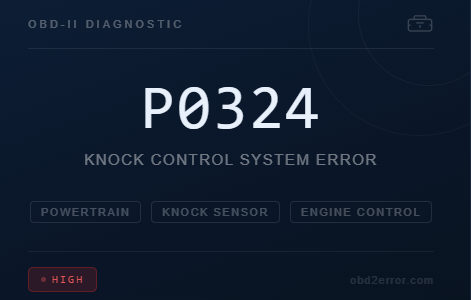
The P0324 code means your engine control module has detected a general fault in the knock control system. This isn’t a specific component failure — it’s the ECM saying the entire knock control system isn’t working as expected. Something in the circuit, the sensor, or the module itself has gone wrong, and the ECM can no longer rely on the knock control system to do its job.
To understand why the P0324 code matters, you need to understand what knock control actually does. Engine knock — also called detonation or pinging — happens when the air-fuel mixture in a cylinder ignites prematurely or unevenly, causing a sharp pressure spike that sounds like a metallic rattling or pinging noise. Left unchecked, knock damages pistons, connecting rods, and bearings. The knock control system exists specifically to prevent this by detecting knock events and retarding ignition timing to stop them.
When the P0324 code is stored, the ECM has lost confidence in the knock control system. It typically responds by defaulting to a conservative ignition timing map — retarding timing more than necessary to be safe. The result is reduced power and worse fuel economy, but the engine is protected from knock damage even without a functioning knock sensor.
If you’ve been dealing with related codes like P0325 or P0326, the P0324 code is the broader system-level fault that often accompanies or precedes those more specific codes.
What You’ll Notice
- Check engine light on
- Noticeable reduction in engine power, especially under load
- Worse fuel economy than normal
- Engine feels sluggish during acceleration
- Possible pinging or knocking sound from the engine under hard acceleration
- Reduced performance at high altitude or when using lower octane fuel
- On some vehicles, the engine enters a “safe mode” with restricted performance
One thing that catches people off guard with the P0324 code is that the car still runs. It might feel less responsive than usual, but it doesn’t stall and it doesn’t refuse to start. Because the symptoms are subtle compared to something like a P0322 no-start condition, the P0324 code often gets put on the back burner. That’s a mistake — running without a functional knock control system means any actual knock event goes undetected and uncorrected.
How the Knock Control System Works
Before getting into causes and diagnosis, it’s worth understanding what the knock control system actually consists of — because the P0324 code can originate in any part of it.
The system has three main components:
Knock sensor: A piezoelectric sensor mounted on the engine block that vibrates in response to the specific frequency of engine knock. It converts that vibration into a small voltage signal and sends it to the ECM or knock control module.
Knock control module: On some vehicles, a dedicated module processes the knock sensor signal before passing it to the ECM. On others, the ECM handles this directly. When a separate knock control module is present, a fault in that module can trigger the P0324 code independently of the sensor.
ECM knock processing: The ECM receives the knock signal, analyzes it, and adjusts ignition timing in real time. If the ECM detects that the knock control system’s overall performance is compromised — not just a single sensor — it stores the P0324 code.
According to SAE J1979 OBD-II standards, the P0324 code is a general knock control system fault, distinct from the individual sensor codes (P0325–P0334) which point to specific sensors or circuits.
What Usually Causes the P0324 Code
1. Faulty knock sensor The most common cause of the P0324 code. The knock sensor has failed — either completely or in a way that produces an unreliable signal. On many engines, particularly inline 4-cylinder and V6 engines, the knock sensor is mounted on the engine block between cylinders and can be difficult to access. It’s worth noting that knock sensors fail more commonly on engines that have experienced overheating, as the high temperatures damage the piezoelectric element inside the sensor.
2. Damaged knock sensor wiring or connector The wiring between the knock sensor and the ECM or knock control module runs close to the engine block, where it’s exposed to heat and vibration. A chafed wire, corroded connector, or broken terminal interrupts the signal and triggers the P0324 code. On many Toyota and Lexus vehicles, the knock sensor wiring harness runs under the intake manifold, where it’s particularly vulnerable to heat damage over time.
3. Failed knock control module On vehicles equipped with a separate knock control module, failure of that module triggers the P0324 code regardless of whether the sensor itself is functioning. This is more common on older European vehicles where knock control was handled by a separate unit rather than being integrated into the main ECM.
4. Loose knock sensor The knock sensor must be torqued to a very specific value — typically between 15 and 20 Nm depending on the manufacturer. A sensor that’s been undertorqued (often after a DIY installation) or has loosened due to vibration over time doesn’t make proper contact with the engine block. Without solid contact, it can’t detect the vibration pattern of engine knock accurately, and the ECM detects this as a system performance fault.
5. Engine mechanical noise This one surprises people. The knock sensor is designed to detect a specific frequency range associated with detonation. Excessive mechanical noise from worn engine bearings, a loose timing chain, or a failing water pump can produce vibrations that the knock sensor picks up as knock-like signals. The ECM may interpret this as a system error rather than a genuine knock event, storing the P0324 code as a result.
6. Software or calibration issue On some vehicles, a software fault or an ECM that’s been flashed with incorrect calibration data can cause the P0324 code to appear without any hardware fault. This is more common after aftermarket tuning or following an ECM reprogram that wasn’t completed correctly.
7. Coolant or oil contamination The knock sensor is mounted on the engine block, and on some engine designs it sits close to coolant passages or oil galleries. A leaking intake manifold gasket, a weeping core plug, or an oil leak that allows fluid to contact the sensor or its connector can cause the sensor to fail or the connector to corrode — triggering the P0324 code.
How Serious Is the P0324 Code?
Serious — though not as immediately dramatic as a no-start code.
The ECM’s response to the P0324 code — defaulting to conservative timing — protects the engine from knock damage in the short term. But “conservative timing” means the engine is running less efficiently than it should. You’re getting less power and burning more fuel than the engine is capable of delivering.
More importantly, if actual engine knock occurs while the P0324 code is active, the ECM may not be able to respond to it correctly. A knock event that goes uncorrected for even a short period can cause serious internal engine damage — damaged pistons, spun bearings, and cracked ring lands are all possible consequences of sustained detonation.
Don’t treat the P0324 code as a “monitor and wait” fault. Fix it promptly, especially if you’re driving in conditions that promote knock — high load, high altitude, or lower octane fuel.
How to Diagnose the P0324 Code
Step 1 — Read all stored codes and freeze frame data
Confirm P0324 and look for companion codes. Individual knock sensor codes like P0325, P0326, P0327, or P0328 alongside P0324 help narrow down whether it’s the sensor, the wiring, or the system as a whole. The freeze frame data tells you the conditions when the P0324 code was stored — engine load, RPM, and temperature are all useful for reproducing the fault.
Step 2 — Locate the knock sensor
The knock sensor location varies considerably by engine. Common locations include:
- On the engine block between the cylinder banks (V6 and V8 engines)
- On the side of the engine block near the middle cylinders (inline engines)
- Under the intake manifold on some Toyota and Honda engines — requiring intake removal for access
Consult your vehicle’s service manual or a reliable resource like the NHTSA vehicle database for the exact location on your engine.
Step 3 — Inspect the sensor and connector
Once located, inspect the knock sensor body and connector carefully. Look for:
- Cracks in the sensor body
- Corrosion on the connector terminals
- Any signs of oil or coolant contamination around the sensor mount
- The torque of the sensor — a sensor that can be moved by hand is undertorqued
Disconnect the connector and clean any corrosion with electrical contact cleaner. Reconnect firmly and clear the P0324 code. If it returns immediately without running the engine, the fault is likely in the connector or wiring rather than the sensor itself.
Step 4 — Test knock sensor resistance
Using a multimeter, measure the resistance between the knock sensor terminals. Compare the reading to the manufacturer’s specification — most knock sensors measure between 100 kΩ and 10 MΩ depending on the design. A reading of zero (short circuit) or infinite resistance (open circuit) confirms the sensor has failed.
Note that resistance testing alone doesn’t fully confirm a knock sensor is good — a sensor can test within resistance spec but still fail to produce an accurate signal under operating conditions. If resistance tests fine but the P0324 code persists, the next step is signal testing.
Step 5 — Test the knock sensor signal
Connect an oscilloscope to the knock sensor output wire. With the engine running, tap the engine block near the sensor with a wrench or hammer handle. A functional knock sensor produces a voltage spike in response to the impact. No response — or a very weak one — confirms the sensor isn’t generating a usable signal.
Step 6 — Check wiring continuity
Test continuity between the knock sensor connector and the ECM connector. Any wire showing no continuity has a break. Check for shorts to ground as well — a knock sensor wire shorted to ground produces incorrect readings that can trigger the P0324 code.
Step 7 — Check sensor torque
If the sensor and wiring test fine, verify the sensor torque using a torque wrench. The correct torque specification is critical for knock sensors — undertorqued sensors don’t maintain proper contact with the block, and overtorqued sensors can crack. Typical specification is 15–20 Nm, but always verify for your specific engine.
Step 8 — Check for engine mechanical noise
If all electrical components check out, listen carefully to the engine for unusual mechanical sounds — ticking, rattling, or knocking that isn’t detonation. Excessive mechanical noise can confuse the knock sensor system and produce system-level faults like P0324. A mechanic’s stethoscope helps isolate the source.
How to Fix the P0324 Code
Replace the knock sensor — The most common fix for P0324. Knock sensors are relatively inexpensive, but labor costs can be significant if the sensor is located under the intake manifold. On engines like Toyota’s V6s and many Honda engines, the intake manifold must be removed for access — factor this into your repair decision.
Repair wiring and connectors — If the wiring harness is damaged or the connector is corroded, repair or replace the affected sections. Use proper automotive connectors and ensure all splices are properly insulated and secured.
Retorque the sensor — If the sensor is loose, retorque it to specification. This is free and takes five minutes — always check this before replacing the sensor.
Replace the knock control module — On vehicles with a separate knock control module, replacement of the module fixes P0324 when the module itself has failed. The module is usually located in the engine bay fuse and relay box or on the firewall.
ECM reprogram — If a software fault is causing P0324, a dealer or specialist can reflash the ECM with the correct calibration data.
Address engine mechanical issues — If excessive engine noise is triggering the knock control system, the mechanical issue needs to be repaired. This could range from a simple timing chain tensioner replacement to more significant engine work depending on the source of the noise.
P0324 on Specific Vehicle Makes
Toyota and Lexus: The P0324 code is particularly common on Toyota V6 engines (1MZ-FE, 2GR-FE, 3GR-FSE). On these engines, the knock sensors are located under the intake manifold and the wiring harness frequently degrades due to heat exposure over time. Intake manifold removal is required for sensor access — budget for 3-5 hours of labor on these engines.
Honda and Acura: On Honda K-series and J-series engines, P0324 often relates to a failed knock sensor or damaged wiring near the sensor mount. The sensors on K-series engines are accessible without major disassembly.
Nissan and Infiniti: VQ-series V6 engines from Nissan are known for knock sensor failures that produce P0324. Like Toyota’s V6, the sensors on many VQ engines are located under the intake manifold.
BMW: On BMW inline 6 and V8 engines, P0324 can sometimes be traced to a failing knock control module rather than the sensor itself. BMW uses a separate knock control module on many models, and module failures are a known issue on higher-mileage examples.
General Motors: On GM LS-series and LT-series engines, P0324 is relatively uncommon but can occur on high-mileage engines where the knock sensor wiring harness has deteriorated. The sensors on these engines are accessible without major disassembly.
What It Might Cost to Fix the P0324 Code
| Repair | Estimated Cost |
|---|---|
| Knock sensor replacement (accessible) | $80 – $250 |
| Knock sensor replacement (under intake) | $300 – $700 |
| Wiring / connector repair | $100 – $400 |
| Knock control module replacement | $150 – $500 |
| ECM reprogram | $80 – $200 |
| Intake manifold removal (labor only) | $200 – $400 |
Labor costs vary significantly by vehicle. Toyota and Nissan V6 engines with under-intake sensors can cost $400–$700 in labor alone. Always get a vehicle-specific quote.
Related Codes
- P0322 — Ignition/Distributor Engine Speed Input Circuit No Signal
- P0323 — Ignition/Distributor Engine Speed Input Circuit Intermittent
- P0325 — Knock Sensor 1 Circuit Malfunction Bank 1
- P0326 — Knock Sensor 1 Circuit Range/Performance Bank 1
- P0327 — Knock Sensor 1 Circuit Low Input Bank 1
- P0328 — Knock Sensor 1 Circuit High Input Bank 1
- P0330 — Knock Sensor 2 Circuit Malfunction Bank 2
- P0300 — Random/Multiple Cylinder Misfire Detected
Frequently Asked Questions
Can I drive with the P0324 code? Short trips are possible since the ECM defaults to conservative timing. But running without a functional knock control system means any actual detonation goes undetected. If you hear pinging or knocking under acceleration, stop driving immediately — you’re risking serious engine damage. Get the P0324 code diagnosed as soon as possible.
Will the P0324 code cause my engine to knock? Not directly. The P0324 code means the knock control system isn’t functioning — it doesn’t cause knock by itself. But it does mean the safety net that normally prevents knock damage isn’t working. If conditions that promote knock occur — low octane fuel, high load, high temperature — the engine is more vulnerable.
How do I know if my knock sensor is under the intake manifold? Check your vehicle’s service manual for the knock sensor location. As a general rule, if your vehicle is a Toyota, Lexus, or Nissan V6, the knock sensors are almost certainly under the intake manifold. Search your specific make, model, and engine code alongside “knock sensor location” to confirm before starting any work.
Can using the wrong fuel cause the P0324 code? Consistently using lower octane fuel than recommended causes more knock events, which increases the workload on the knock control system. While this alone doesn’t directly cause P0324, it accelerates wear on the knock sensor and associated components. Always use the minimum octane rating specified in your owner’s manual.
Is the P0324 code the same as a knock sensor code? Not exactly. The P0324 code is a system-level fault — it means the entire knock control system has an issue. Individual knock sensor codes like P0325, P0326, P0327, and P0328 are more specific and point to a particular sensor or aspect of the circuit. P0324 can appear alongside these codes or on its own when the ECM detects a broader system problem.
Can a DIY sensor replacement cause P0324? Yes — if the sensor isn’t torqued correctly. Overtightening a knock sensor cracks the piezoelectric element inside it, causing it to fail immediately or produce incorrect readings. Undertightening means the sensor doesn’t maintain proper contact with the engine block. Always use a torque wrench when installing a knock sensor, and verify the specification for your specific engine.
How long does it take to fix the P0324 code? It depends entirely on sensor location. On engines where the knock sensor is externally accessible, replacement takes 30–60 minutes. On engines where intake manifold removal is required, budget for 3–6 hours of labor. Get a vehicle-specific estimate before authorizing any work.
For more information on engine knock, detonation, and OBD-II diagnostic standards, visit the National Highway Traffic Safety Administration (NHTSA) or refer to your vehicle’s official service manual.
This guide is for informational purposes only. For an accurate diagnosis, always consult a qualified mechanic.