OBD2 Error Codes: Complete List, Lookup Guide & How to Read Them
OBD2 error codes are how your car tells you something is wrong. Every time the check engine light comes on, there’s at least one OBD2 error code stored in your vehicle’s computer — a specific alphanumeric code that points to the system or component that triggered the warning.
Understanding OBD2 error codes doesn’t require a mechanic’s degree. Once you know how the system works, what the codes mean, and how to look them up, you can diagnose most check engine light situations yourself — or at least know what you’re dealing with before you take the car to a shop.
This guide covers everything you need to know about OBD2 error codes: how to read them, how to look them up, the most common fault codes and what they mean, and where to find a complete OBD2 code list.
What Are OBD2 Error Codes?
OBD2 error codes — also called diagnostic trouble codes (DTCs), fault codes, or car error codes — are standardized codes stored by your vehicle’s onboard diagnostic system when it detects a fault. The “OBD2” refers to the second generation of On-Board Diagnostics, which became mandatory on all vehicles sold in the United States from 1996 onwards, and has since been adopted globally.
When a sensor reading falls outside expected parameters, or when a system fails a self-test, the OBD2 system stores the relevant fault code and — depending on the severity — illuminates the check engine light. The code stays stored until it’s cleared, either by a mechanic using a scan tool or by the system itself after the fault no longer appears over several drive cycles.
OBD2 error codes are standardized across manufacturers by the Society of Automotive Engineers (SAE), which means a P0420 code means the same thing on a Toyota as it does on a Ford — catalyst efficiency below threshold. This standardization makes OBD2 codes one of the most useful diagnostic tools available to both professional mechanics and vehicle owners.
How to Read OBD2 Error Codes
Every OBD2 error code follows the same five-character structure: one letter followed by four numbers.
The first character — the letter — tells you which system:
- P — Powertrain (engine, transmission, fuel system, emissions)
- B — Body (airbags, power windows, central locking, climate control)
- C — Chassis (ABS, brakes, suspension, steering)
- U — Network (communication between modules, CAN bus)
The second character — the first number — tells you who defined the code:
- 0 — Generic (SAE standardized, same on all vehicles)
- 1 — Manufacturer specific (varies by make and model)
- 2 — Generic or manufacturer specific depending on the system
- 3 — Generic or manufacturer specific depending on the system
The third character tells you the subsystem:
- 1 — Fuel and air metering
- 2 — Fuel and air metering (injector circuit)
- 3 — Ignition system or misfires
- 4 — Auxiliary emission controls
- 5 — Vehicle speed, idle control, auxiliary inputs
- 6 — Computer and output circuits
- 7 — Transmission
The last two characters are the specific fault number within that subsystem.
So P0301 breaks down as: P = Powertrain, 0 = Generic, 3 = Ignition/misfire, 01 = Cylinder 1 misfire. Simple once you know the pattern.
How to Look Up OBD2 Error Codes
There are several ways to look up OBD2 error codes depending on the tools and resources available to you.
OBD2 Scanner
The most reliable method. An OBD2 scanner plugs into the diagnostic port under your dashboard — typically on the driver’s side near the steering column. The scanner reads the stored codes and displays them. Basic scanners show the code number; more advanced ones show a description, live sensor data, and freeze frame information.
Entry-level OBD2 scanners start at around $20-30 and are available at most auto parts stores. More capable scanners that show live data and manufacturer-specific codes cost $80-300.
OBD2 Fault Codes App
A popular and affordable alternative to a dedicated scanner. An OBD2 fault codes app works with a Bluetooth or WiFi OBD2 adapter that plugs into the diagnostic port. The adapter communicates with the app on your smartphone, which displays the codes, descriptions, and often additional diagnostic information.
Popular OBD2 fault codes apps include Torque Pro, OBD Fusion, Car Scanner, and FIXD. Most are available for both iOS and Android. The adapter costs $15-50 and many of the apps are free or low cost. For basic OBD2 error code reading, an app-based setup works as well as a dedicated scanner.
Free Code Reading at Auto Parts Stores
Most major auto parts chains offer free OBD2 error code reading. Staff will plug a scanner into your vehicle’s diagnostic port and print out the codes. This is a good option if you don’t own a scanner and just need to know what codes are stored.
OBD2 Codes Lookup Websites
Once you have the code number, a quick search brings up detailed information. Sites like obd2error.com provide comprehensive explanations of OBD2 error codes, including causes, symptoms, diagnostic procedures, and repair costs. This is the most practical OBD2 codes lookup method for understanding what a code actually means and what to do about it.
OBD2 Code List PDF
Many vehicle manufacturers and automotive organizations publish a complete OBD2 code list PDF covering all generic SAE codes. These are useful reference documents but are typically long — the full SAE generic code list runs to thousands of entries. For practical diagnosis, a specific code search is more efficient than browsing a complete OBD2 code list PDF.
OBD2 Code List: The Most Common Fault Codes
Rather than listing thousands of OBD2 error codes, here are the most frequently encountered fault codes organized by category — the ones most likely to appear on your scanner.
Most Common Powertrain (P) Codes
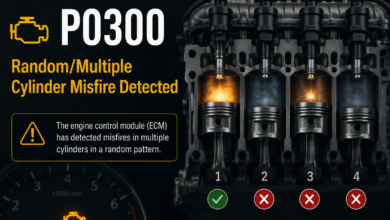
P0300 — Random/Multiple Cylinder Misfire Detected One of the most common OBD2 error codes. Misfires across multiple cylinders, usually from worn spark plugs, a failing ignition coil, or a fuel delivery issue.
P0301 – P0308](https://obd2error.com/p0306-code/) — Cylinder-Specific Misfire Codes Each of these codes identifies a misfire in a specific cylinder. P0301 = cylinder 1, P0302 = cylinder 2, and so on. Typically caused by a worn spark plug or failing ignition coil on the affected cylinder.
P0171 — System Too Lean Bank 1 The engine on bank 1 is running with too much air or too little fuel. Common causes include a vacuum leak, a dirty MAF sensor, or low fuel pressure.
P0420 — Catalyst System Efficiency Below Threshold Bank 1 The catalytic converter on bank 1 is no longer processing exhaust gases efficiently. Can also be caused by a faulty oxygen sensor rather than a failed converter.
P0128 — Coolant Temperature Below Thermostat Regulating Temperature The engine isn’t reaching normal operating temperature. Usually a failing thermostat stuck in the open position.
P0401 — Exhaust Gas Recirculation Flow Insufficient The EGR system isn’t flowing enough exhaust gas back into the intake. Carbon buildup in the EGR valve or passages is the most common cause.
P0442 / P0455 — Evaporative Emission System Leak A small or large leak in the fuel vapor recovery system. Often as simple as a loose or damaged fuel cap.
P0507 — Idle Control System RPM High Engine idling higher than it should. Typically a vacuum leak or a throttle body that needs cleaning.
Most Common Chassis (C) Codes
C0035 — Left Front Wheel Speed Sensor Circuit Malfunction C0040 — Right Front Wheel Speed Sensor Circuit Malfunction C0045 — Left Rear Wheel Speed Sensor Circuit Malfunction
Wheel speed sensor codes are among the most common chassis OBD2 error codes. They disable ABS and traction control and are usually caused by a failed sensor, damaged wiring, or a corroded connector.
Most Common Body (B) Codes
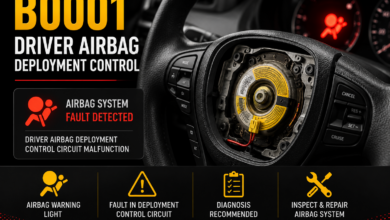
B0001 — Driver Airbag Deployment Control B0010 — Driver Side Airbag Circuit Malfunction
Airbag system codes are serious — they indicate the airbag may not deploy in a crash. Most commonly caused by a faulty clock spring, damaged wiring, or a failed airbag sensor.
Most Common Network (U) Codes
U0100 — Lost Communication With ECM/PCM U0101 — Lost Communication With TCM U0121 — Lost Communication With ABS Control Module U0140 — Lost Communication With Body Control Module U0155 — Lost Communication With Instrument Panel
Network communication codes indicate a module has gone offline. Usually caused by a weak battery, damaged CAN bus wiring, or a faulty module.
Car Diagnostic Codes List: Generic vs Manufacturer Specific
The OBD2 fault codes system has two tiers — generic codes and manufacturer-specific codes.
Generic OBD2 error codes (second digit 0) are standardized by SAE and mean the same thing on every vehicle. These are the codes covered in a standard car diagnostic codes list or OBD2 code list PDF. Any OBD2 scanner can read them.
Manufacturer-specific codes (second digit 1, 2, or 3) are defined by individual manufacturers and cover systems and conditions not addressed by the generic code set. A Toyota P1349 (VVT system malfunction) means something specific to Toyota — it won’t appear in a standard OBD2 codes lookup for generic codes. Reading manufacturer-specific codes sometimes requires a scanner compatible with that manufacturer’s protocol, or a dealer-level tool.
When building a car error code list for your vehicle, it’s worth knowing whether the codes on your scanner are generic or manufacturer-specific — because the diagnostic approach can be different.
OBD2 Codes Lookup: Tips for Accurate Diagnosis
Having the OBD2 error code is only the starting point. Here’s how to use it effectively:
Read all codes, not just one. Multiple codes stored at the same time tell a more complete story. A P0171 (lean bank 1) stored alongside a P0174 (lean bank 2) points toward a different cause than P0171 alone.
Check the freeze frame data. Most OBD2 scanners store a snapshot of sensor data at the moment the fault was detected. The freeze frame shows engine RPM, load, temperature, and speed at the time of the fault — invaluable context for diagnosis.
Note pending codes. A pending code is one that’s been detected once but not confirmed as a permanent fault. Pending codes don’t illuminate the check engine light but are often the first sign of a developing problem.
Don’t just clear the code. Clearing OBD2 error codes without fixing the underlying fault just resets the counter. The code returns on the next drive cycle if the fault is still present — and clearing codes also erases the freeze frame data that helps with diagnosis.
Cross-reference with symptoms. An OBD2 codes lookup gives you the code definition, but the symptoms the driver experiences are often the best clue to the actual root cause. A P0300 random misfire code combined with symptoms that are worse when cold points toward different causes than the same code with symptoms that appear only under heavy load.
Car Error Code List: Understanding Severity
Not all OBD2 error codes are equally urgent. Understanding the severity helps prioritize repairs correctly.
Immediate attention required:
- Flashing check engine light — active misfire severe enough to damage the catalytic converter
- P0325–P0333 (knock sensor codes) — engine running without detonation protection
- Any U-series communication code combined with a no-start condition
- B0001, B0010, or any airbag-related code — safety system compromised
Address promptly (within days to weeks):
- P0300–P0309 (misfire codes) — catalytic converter damage accumulates over time
- C0035, C0040, C0045 (wheel speed sensor codes) — ABS and traction control disabled
- P0171, P0174 (lean codes) — engine running lean causes long-term wear
Monitor and address at next service:
- P0128 (thermostat) — affects fuel economy but not immediately damaging
- P0442 (small EVAP leak) — emissions fault, not immediately harmful
- P0401 (EGR flow) — affects emissions and efficiency
Frequently Asked Questions
What is the most common OBD2 error code? The P0420 code (catalyst system efficiency below threshold) and the P0300 series (misfire codes) are among the most frequently encountered OBD2 error codes globally. P0171 (system too lean bank 1) and various oxygen sensor codes are also extremely common.
Can I drive with OBD2 error codes stored? It depends entirely on which code is stored. Some OBD2 error codes indicate conditions that make driving unsafe — a flashing check engine light means stop driving as soon as it’s safe. Others indicate faults that affect performance or efficiency but aren’t immediately dangerous. Always look up the specific code before deciding whether to drive.
How do I get a complete OBD2 code list PDF? The SAE publishes the complete generic OBD2 code list, but it’s a technical document. For practical use, sites like obd2error.com provide detailed, readable explanations of individual codes. Many OBD2 fault codes apps also include a built-in code library that functions as a searchable OBD2 codes lookup.
What’s the best OBD2 fault codes app? For general use, Torque Pro (Android) and OBD Fusion (iOS and Android) are highly rated. Car Scanner ELM OBD2 is a strong free option. FIXD is popular for its plain-language code explanations. All require a compatible Bluetooth or WiFi OBD2 adapter.
Why does the same OBD2 error code mean different things on different cars? Generic OBD2 error codes (second digit 0) mean the same thing on all vehicles. But manufacturer-specific codes (second digit 1) are defined by each manufacturer and can mean completely different things on different makes. Always confirm whether a code is generic or manufacturer-specific before looking it up.
Can OBD2 error codes be wrong? The code itself is accurate — it tells you which circuit or system triggered the fault. But the code doesn’t always directly identify the failed component. A P0171 lean code can be caused by a vacuum leak, a dirty MAF sensor, a failed oxygen sensor, or low fuel pressure — the code points to the symptom, not necessarily the root cause. Proper diagnosis uses the code as a starting point, not a final answer.
How many OBD2 error codes are there? The SAE generic code set contains approximately 11,000 standardized OBD2 error codes. Adding manufacturer-specific codes across all major manufacturers brings the total well above that. In practice, a few hundred codes account for the vast majority of real-world check engine light situations.
For official OBD2 diagnostic standards and vehicle safety information, visit the National Highway Traffic Safety Administration (NHTSA) or the SAE International standards library.
This guide is for informational purposes only. For an accurate diagnosis, always consult a qualified mechanic.