P0308 Code: A Natural, Practical Guide to Diagnosing and Fixing a Cylinder 8 Misfire

ew things disrupt a smooth drive quite like a sudden P0308 code illuminating your dashboard’s check engine light. When you connect an OBD2 scanner to trace this error, your vehicle’s onboard computer points a direct, digital finger at a localized problem: a detected misfire occurring specifically within cylinder number 8. This diagnostic trouble code signifies that the Powertrain Control Module (PCM) has tracked an interruption, irregularity, or complete failure in the combustion process of the eighth cylinder. Because this code isolates a single cylinder numbered as high as eight, it is exclusive to larger configuration engines, such as V8, V10, or V12 powerplants. If you are dealing with this code, it means one of your engine’s internal power generators has effectively stepped out of line, leaving the remaining cylinders to pick up the slack, which strains the mechanical integrity of your entire vehicle.

What Does the P0308 Code Actually Mean? An Engine’s Rhythm Broken
To understand what is happening inside your engine when a P0308 code triggers, think of a multi-cylinder engine as a team of synchronized runners. For the vehicle to move smoothly, accelerate effortlessly, and idle without vibration, every single cylinder must deliver an identical, perfectly timed downward push on the engine’s crankshaft. This downward force is generated during the power stroke when the compressed air-fuel mixture is ignited.
The engine’s computer acts as the ultimate referee, continuously watching this team of runners. It does this by monitoring the Crankshaft Position (CKP) sensor and the Camshaft Position (CMP) sensor. The CKP sensor watches a specialized toothed wheel (called a reluctor ring) spinning at thousands of revolutions per minute. Every time a cylinder successfully fires, the crankshaft experiences a microscopic, predictable burst of rotational speed.
If cylinder number 8 fails to fire, or fires with insufficient force, the expected micro-acceleration does not happen. Instead, the crankshaft experiences a brief, distinct drop in speed during the exact millisecond that cylinder 8 was supposed to contribute its power. When the computer detects this micro-deceleration happening repeatedly over a set number of engine cycles, it confirms a persistent problem, illuminates the dashboard light, and logs the P0308 code.
This specific code belongs to a sequential family of codes designed to help drivers and mechanics quickly narrow down their focus. For example, while a P0307 code points the finger directly at the adjacent seventh cylinder, the P0308 code tells you to skip everything else and focus your physical, electrical, and mechanical inspection entirely on cylinder number 8.
The Root of the Problem: Why Cylinder 8?
There is a unique architectural reality to consider when dealing with a cylinder 8 misfire. In a standard domestic or imported V8 engine, cylinder number 8 is almost universally located at the absolute back of the engine block, closest to the vehicle’s firewall. This physical placement makes it inherently susceptible to specific environmental stresses within the engine bay:
- Heat Accumulation: Because it sits at the very rear of the engine block, cylinder 8 often experiences less airflow than the front cylinders, which are constantly cooled by air rushing through the radiator grille and past the cooling fans. Over years of driving, this concentrated heat can accelerate the degradation of rubber ignition coil boots, spark plug wires, and electrical wiring harnesses.
- Debris and Moisture Traps: The rear corners of an engine bay are where moisture, cowl panel leaks, and airborne debris tend to settle. If a windshield cowl seal degrades, rainwater can drip directly onto the top of the engine, pooling inside the deep spark plug wells of the rear cylinders and shorting out the ignition system.
- Fuel Rail Pressure Drop: In some poorly designed or aging fuel delivery systems, fuel travels down a long rail from the front of the engine to the back. If the fuel pump is weak or the fuel filter is partially restricted, the cylinders at the absolute end of the line—like cylinder 8—can be the first to experience a drop in fuel pressure, leading to a lean misfire.
Real-World Symptoms: What a Cylinder 8 Misfire Feels Like
A misfiring cylinder is not something that stays hidden in computer data; it alters the entire sensory experience of driving your car. Depending on whether your misfire is constant (occurring every time the cylinder tries to fire) or intermittent (occurring only under specific conditions like heavy acceleration or damp weather), you will notice a distinct set of warnings.
1. The Behavior of the Check Engine Light
Your dashboard light provides immediate, critical context regarding how dangerous the misfire is to your vehicle’s health:
- A Solid Light: This means the computer has detected a consistent misfire that is increasing vehicle emissions beyond legal limits. While the vehicle is safe to drive home or to a local repair shop, it should not be used for long-term daily commuting.
- A Flashing Light: This is an automotive emergency. A flashing check engine light indicates a “catalyst-damaging” misfire. When this happens, vast amounts of unburnt, raw fuel are being pumped straight past cylinder 8 and down into the exhaust system. This raw fuel hits the white-hot internal ceramic bricks of your catalytic converter, igniting inside the exhaust and melting the precious metals within minutes. If the light flashes, pull over safely, turn off the engine, and call a tow truck.
2. Physical Shaking and Structural Vibrations
Because a large engine relies heavily on rotational balance, losing a cylinder creates a permanent mechanical imbalance. This shows up as a heavy, rhythmic shudder or vibration felt through the steering wheel, your seat, and the floorboards. This vibration is usually most violent when the car is idling at a red light or stop sign. When you press the gas pedal and the engine RPM rises, the sheer momentum of the engine may mask the vibration, but the underlying damage and efficiency loss remain.
3. Engine Hesitation and Severe Power Loss
When you attempt to merge onto a highway, climb a steep hill, or pass another vehicle, the lack of cylinder 8’s power output becomes immediately apparent. The engine will hesitate, bog down, or feel as though it is fighting its own internal weight. It may feel like the transmission is slipping, but it is actually the engine failing to generate its expected torque.
4. Poor Fuel Economy and Pungent Exhaust Odors
When a cylinder experiences a misfire, the fuel injected into that chamber is completely wasted, escaping directly out the exhaust valves. Furthermore, the oxygen sensor detects this unburnt oxygen and misinterprets it as a lean engine condition. The computer responds by dumping extra fuel into all the other cylinders, causing your fuel mileage to plummet. You will likely notice a heavy smell of raw gasoline or a sulfur-like “rotten egg” odor coming from the tailpipe.
Detailed Breakdown of Causes: What Triggers a P0308 Code?
To successfully resolve a P0308 code without wasting hundreds of dollars on parts you do not need, you must categorize potential causes into three main functional categories: Spark, Fuel, and Mechanical/Compression.
1. Ignition System Failures (The Most Common Culprits)
- Worn or Fouled Spark Plug: The spark plug in cylinder 8 may have reached the end of its natural lifespan. As the electrodes erode, the gap between them grows too wide for the ignition system to bridge. Alternatively, the plug may be fouled by carbon deposits, oil leaking past worn valve seals, or engine coolant, preventing a clean arc from forming.
- Failed Ignition Coil (Coil-on-Plug): Most modern vehicles utilize an individual ignition coil sitting directly on top of each spark plug. Internal electrical shorts caused by heat, age, or vibration can cause the cylinder 8 coil to stop producing the high-voltage charge required to light the air-fuel mixture.
- Bad Spark Plug Wires or Boots: On older engines with a central distributor or pack system, the long spark plug wire leading to cylinder 8 can break down internally, allowing the electrical current to leak out through the insulation. On modern systems, the rubber boot extending from the coil can crack, causing the spark to jump to the metal cylinder head before ever reaching the spark plug tip.
2. Fuel Delivery Impediments
- Clogged or Restricted Fuel Injector: If the fuel injector for cylinder 8 becomes partially blocked by fuel varnish, carbon crusting, or fine debris, it will fail to spray an adequate volume of finely atomized fuel. This creates a “lean misfire,” where there simply isn’t enough fuel in the chamber to sustain a flame.
- Electrical Circuit Faults: The fuel injector relies on an explicit electrical pulse from the PCM. If the wiring harness leading to the cylinder 8 injector is melted by exhaust heat, chewed by rodents, or corroded at the connector clip, the injector will fail to open.
- Leaking Injector: Conversely, if an injector is stuck open or leaking, it will flood cylinder 8 with excessive fuel, causing a “rich misfire” because the mixture is too dense to ignite cleanly.
3. Internal Mechanical and Compression Discrepancies
- Intake Manifold Vacuum Leaks: The intake manifold distributes air to all cylinders. If the gasket seals around the intake runner for cylinder 8 shrink, crack, or blow out, the engine will draw unmetered “outside” air directly into that specific cylinder. This disrupts the carefully calculated air-fuel ratio, causing a localized misfire.
- Blown Head Gasket: The head gasket creates a tight seal between the engine block and the cylinder head. If the gasket develops a localized blowout near cylinder 8, compression will escape into the cooling system, oil passages, or the open air, leaving the cylinder unable to build the pressure required for a complete combustion cycle.
- Valvetrain Mechanical Wear: If an intake or exhaust valve inside cylinder 8 becomes bent, burnt, or coated in excessive carbon buildup, it will fail to seal tightly against the cylinder head. Additionally, a worn camshaft lobe or a collapsed hydraulic lifter can prevent the valves from opening far enough to let air in or exhaust out.
                  ┌──────────────────────────────────────────────┐
                  │            P0308 Diagnostic Loop             │
                  └──────────────────────┬───────────────────────┘
                                         │
                 ┌───────────────────────┼───────────────────────┐
                 ▼                       ▼                       ▼
      ┌─────────────────────┐ ┌─────────────────────┐ ┌─────────────────────┐
      │   Ignition Path     │ │      Fuel Path      │ │   Mechanical Path   │
      └──────────┬──────────┘ └──────────┬──────────┘ └──────────┬──────────┘
                 ├─ Coil Swap            ├─ Noid Light Test      ├─ Smoke Test
                 ├─ Plug Inspection      ├─ Resistance Check     ├─ Compression
                 └─ Wire Check           └─ Fuel Pressure        └─ Leak-Down
Step-by-Step Diagnostic Protocol: Thinking Like a Pro
Do not guess which part is broken. Guessing leads to unnecessary spending and ongoing frustration. Instead, approach the P0308 code with a logical, step-by-step diagnostic workflow designed to isolate the failure mode through a clear process of elimination.
Step 1: Analyze Freeze Frame and Live Diagnostic Data
Plug your diagnostic tool into your vehicle’s OBD2 port and retrieve the stored data. Pay close attention to the Freeze Frame Data, which captures a snapshot of exactly what your engine was doing when the P0308 code was set. Note the engine RPM, vehicle speed, and engine coolant temperature. Next, look at your Fuel Trims:
- Highly Positive Fuel Trims (+10% or higher): Indicates that the computer is trying to add fuel to correct a perceived lean condition. This points strongly toward a vacuum leak near cylinder 8 or a clogged fuel injector.
- Highly Negative Fuel Trims (-10% or lower): Indicates that the computer is pulling fuel away to correct a rich condition. This points toward a leaking fuel injector or an ignition system that isn’t burning the fuel provided.
Step 2: Utilize the Ignition Component Swap Test
The absolute fastest way to check your ignition system without special testing tools is the component swap method.
- Turn off the ignition, open the hood, and locate cylinder number 8.
- Carefully disconnect the electrical connector and remove the ignition coil from cylinder 8.
- Remove an identical ignition coil from a known working cylinder (such as cylinder 6).
- Install the cylinder 8 coil onto cylinder 6, and install the cylinder 6 coil onto cylinder 8.
- Use your diagnostic tool to clear all existing trouble codes.
- Start the engine and drive the vehicle under the same conditions recorded in your freeze frame data until the check engine light illuminates again.
- Re-scan the codes. If the code has shifted from P0308 to P0306, the misfire followed the coil. Your ignition coil is defective and needs replacement. If the code returns as P0308, your coil is fine. Move to the next step.
Step 3: Inspect the Spark Plug Core
Remove the spark plug from cylinder 8 and look closely at its physical condition. The tip of a healthy spark plug should have a light tan or greyish color.
- If the plug is covered in heavy black carbon, it means the cylinder is getting fuel but lacking a strong, consistent spark.
- If the plug is wet with raw gasoline, the ignition system is completely dead, or the injector is flooding the chamber.
- If the plug is coated in thick, wet engine oil, oil is entering the combustion chamber past worn valve stem guides or defective piston rings, fouling the plug.
- If the plug has a cracked ceramic insulator, the spark is grounding out inside the engine block rather than firing across the electrode tip. Replace the plug immediately.
Step 4: Check Injector Operation via Noid Light and Resistance
If your ignition system is fully validated, move your focus to fuel delivery. Disconnect the electrical wiring harness from the cylinder 8 fuel injector. Plug an automotive Noid Light directly into the harness connector and crank the engine. If the light pulses rhythmically, it proves that your PCM is healthy and sending the correct electrical commands to fire the injector.
Next, switch your digital multimeter to the ohms setting and measure the resistance across the two male pins of the cylinder 8 fuel injector. Compare this number against the factory specifications or against the resistance of neighboring injectors. A reading of zero ohms indicates a shorted injector, while a reading of infinity indicates an open circuit. In either case, the injector must be replaced.
Step 5: Conduct a Mechanical Engine Compression Test
If your ignition components are working and your fuel injector is operating correctly, your misfire is being caused by an internal mechanical failure. It is time to check if cylinder 8 can physically compress its air-fuel mixture.
- Remove the spark plug from cylinder 8.
- Thread an automotive compression gauge securely into the spark plug opening.
- Disable your fuel system (remove the fuel pump relay or fuse) to prevent fuel from spraying during the test.
- Have an assistant press the accelerator pedal flat to the floor (to open the throttle plate completely) and crank the engine over 5 to 6 times.
- Note the maximum pressure reading on the gauge.
- Repeat this exact test on all other cylinders to establish a baseline.
The 15% Rule: For an engine to run smoothly, the compression reading of your lowest cylinder must be within 15% of your highest cylinder. If your other cylinders read 150 PSI, but cylinder 8 reads below 120 PSI, cylinder 8 lacks the mechanical integrity to fire correctly, pointing to internal mechanical damage.
Comprehensive Repair Matrix: Balancing Fixes and Budgets
Fixing a P0308 code can range from a quick, inexpensive DIY project to an extensive, professional engine teardown. The financial matrix below outlines typical repair strategies, part costs, and expected shop labor times.
| Identified Root Cause | Corrective Repair Action | Estimated Parts Cost (USD) | Estimated Shop Labor Time |
| Fouled / Worn Spark Plug | Replace spark plug (Highly recommended to replace as a complete set) | $8 – $25 (per plug) | 0.5 – 1.5 Hours |
| Failed Ignition Coil | Replace cylinder 8 ignition coil pack | $35 – $130 | 0.5 – 1.0 Hours |
| Defective Spark Plug Wire | Install a new high-quality plug wire set | $40 – $90 (set) | 0.5 – 1.5 Hours |
| Restricted Fuel Injector | Replace cylinder 8 fuel injector | $55 – $210 | 1.0 – 3.0 Hours |
| Leaking Intake Manifold Gasket | Remove intake manifold and install new gaskets | $25 – $75 | 2.5 – 5.0 Hours |
| Blown Head Gasket | Tear down top end, machine head, replace gasket | $160 – $350 | 9.0 – 16.0 Hours |
| Collapsed Valve Lifter | Replace lifters and inspect the camshaft | $150 – $400 | 8.0 – 14.0 Hours |
Platform-Specific Quirks: Real-World Vehicle Tendencies
While the OBD2 system is a universal standard, different car manufacturers design their engines with distinct characteristics. Over years of real-world use, certain vehicle platforms have developed well-documented patterns when dealing with a P0308 code:
1. General Motors (5.3L, 6.0L, 6.2L V8 Vortec & EcoTec3 Engines)
If you drive a Chevy Silverado, GMC Sierra, Tahoe, or Yukon equipped with Active Fuel Management (AFM) or Dynamic Fuel Management (DFM) cylinder deactivation systems, pay close attention. These systems turn off specific cylinders during highway cruising to save fuel by using specialized, oil-pressure-controlled collapsible lifters.
Cylinder number 8 is one of the primary cylinders chosen for deactivation. If engine oil changes are neglected, or if internal oil pressure drops, the internal mechanism inside the cylinder 8 lifter can collapse permanently or lock up mechanically. This keeps the valves closed, creating an immediate, severe P0307 or P0308 code accompanied by a loud ticking sound coming from beneath the valve cover.
2. Dodge / RAM / Jeep (5.7L & 6.4L Hemi V8 Engines)
The legendary Chrysler Hemi V8 engine is highly susceptible to a specific mechanical failure colloquially known as the “Hemi Tick.” The hydraulic lifters in these engines are positioned at an angle that can sometimes suffer from oil starvation during prolonged idling.
When a lifter fails, the roller bearing inside stops spinning and locks up. As the engine runs, this seized roller bearing acts like a chisel, rapidly grinding down the lobes of the steel camshaft. Because cylinder 8 sits at the back of the oil galley line, it is a frequent victim of this issue. If your P0308 code is accompanied by a heavy, metallic tapping sound that increases with engine speed, you are likely looking at a worn camshaft and lifter assembly.
3. Ford Trucks & SUVs (4.6L, 5.4L, 6.8L Modular V8/V10 Engines)
For owners of older Ford F-150s, Expeditions, or Mustangs running the Modular engine platform, a P0308 code often stems from two distinct ignition design flaws.
- On early 2-valve engines, the aluminum cylinder heads were designed with very few threads holding the spark plugs in place. Over time, these plugs can loosen, strip out the aluminum threads, and literally blow straight out of the cylinder head while driving, destroying the ignition coil on their way out.
- On later 3-valve engines, the spark plugs feature a unique, elongated two-piece design that accumulates carbon buildup inside the cylinder head. When you attempt to remove the plug from the deep cylinder 8 well, the plug often snaps in half, locking the lower ground electrode sleeve permanently inside the head.
Smart Preventive Measures: Keeping the Misfires Away
The most affordable way to handle a P0308 code is to prevent it from ever showing up in the first place. Incorporating these simple habits into your regular vehicle upkeep will keep your large-displacement engine running smoothly:
- Never Skip Spark Plug Service Intervals: Do not wait for a misfire to force your hand. Standard copper plugs should be replaced every 30,000 miles, while advanced Platinum or Iridium plugs can reliably last between 60,000 and 100,000 miles. Replacing them early prevents added electrical stress on your ignition coils.
- Keep Your Engine Oil Fresh: This is critical for vehicles with cylinder deactivation or variable valve timing (VVT) systems, like GM AFM or RAM Hemi platforms. Clean oil of the exact factory-recommended viscosity ensures that hydraulic lifters receive proper lubrication, preventing mechanical collapse.
- Run a High-Quality Fuel System Cleaner: Once every few months, add a dedicated fuel injector cleaner containing Polyetheramine (PEA) directly into your gas tank. PEA is a powerful detergent that survives the intense heat of combustion, dissolving stubborn carbon crusts and varnish off your injector nozzles to maintain an optimal fuel spray pattern.
- Inspect Weatherstripping and Cowl Seals: Periodically check the rubber seals running along the bottom of your windshield cowl panel. If these seals dry out or crack, rainwater can flow directly into the rear of your engine bay, flooding the deep wells of cylinder 8 and destroying your ignition components.
FAQ: Frequently Asked Questions About the P0308 Code
1. Is it safe to continue driving with a P0308 error code active?
No, it is highly unadvisable to continue driving with an active P0308 code. A misfiring cylinder pumps unburnt fuel directly into your hot exhaust system. This raw fuel will quickly enter your catalytic converter, causing internal temperatures to skyrocket. This can melt the internal components of the converter, transforming a relatively simple repair into a multi-thousand-dollar exhaust overhaul.
2. Can a simple vacuum leak cause a single-cylinder code like P0308?
Yes, it can. While massive vacuum leaks usually cause engine-wide codes like P0171 or a random misfire code like P0300, a highly localized vacuum leak can occur. If the intake manifold gasket develops a crack, gap, or tear specifically around the individual intake runner port that routes air into cylinder number 8, that cylinder will receive unmetered outside air. This creates an isolated lean condition in that cylinder alone, triggering a P0308 code.
3. How do I physically identify which cylinder is number 8 on my vehicle?
Cylinder layout and numbering schemas depend entirely on your vehicle’s manufacturer.
- General Motors & Fiat Chrysler (RAM/Jeep): If you are sitting in the driver’s seat looking forward, the cylinders on the left side of the engine bay (the driver’s side) are numbered with odd numbers (1-3-5-7), and the passenger side holds even numbers (2-4-6-8). Cylinder 8 will be the cylinder located at the very back of the engine block on the passenger side.
- Ford: Ford numbers their cylinders sequentially from front to back. The passenger side holds cylinders 1 through 4, and the driver’s side holds cylinders 5 through 8. On a Ford V8, cylinder 8 is located at the very back of the engine block on the driver’s side.
4. Will replacing my spark plugs automatically clear the P0308 code?
If a worn-out or fouled spark plug was the true root cause of the misfire, replacing it will fix the physical problem. However, the trouble code will remain stored in the computer’s history memory until the vehicle completes several successful “drive cycles” without tracking a misfire. To verify your repair instantly, use your OBD2 scanner to manually clear the codes, start the engine, and see if the dashboard light remains off.
5. Why does my cylinder 8 misfire only happen when it rains or during damp mornings?
This is a classic sign of an ignition insulation breakdown. When the air is highly humid or rainwater enters the engine bay, a thin layer of moisture settles onto your ignition components. If your cylinder 8 ignition coil boot or spark plug wire has tiny, microscopic cracks due to age and engine heat, the high-voltage electrical current will take the path of least resistance. It will travel down the wet exterior of the boot to the metal engine block rather than traveling down the center of the spark plug.
6. What is the operational difference between code P0308 and code P0300?
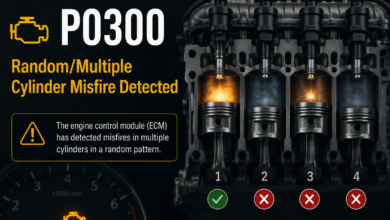
The primary difference comes down to diagnostic specificity. The P0308 code tells you that the engine computer has pinpointed a failure occurring in one specific area: cylinder number 8. A P0300 code is a generic indicator for a “Random/Multiple Cylinder Misfire.” This means the computer detects misfires jumping around across several different cylinders simultaneously, which usually points to a system-wide issue like low fuel rail pressure, a failing mass airflow sensor, or a massive vacuum leak.
7. Can an engine oil leak trigger a P0308 trouble code?
Yes, if the leak is occurring internally or around the top of the engine. If your engine’s valve cover gaskets fail directly above cylinder 8, engine oil will slowly seep downward, filling up the deep spark plug well. Because engine oil is highly conductive, it can submerge the spark plug terminal and cause the high-voltage electrical arc from the ignition coil to ground out into the engine block, preventing the plug from firing and creating a persistent misfire.
8. Could a failing powertrain computer (PCM) falsely report a P0308 code?
While it is technically possible for an internal failure within the PCM’s processing unit or an injector driver circuit to log a false code, this is incredibly rare. Before ever condemning an expensive engine computer, you must thoroughly test and rule out all basic physical variables, including the condition of your spark plugs, the integrity of your ignition coils, the operation of your fuel injectors, and the physical compression readings of the engine cylinder.