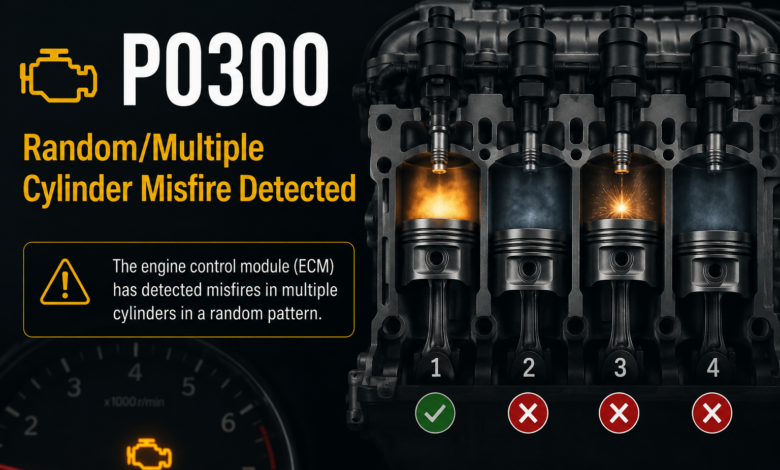
P0300: Random/Multiple Cylinder Misfire Detected
Category: Powertrain Codes
System: Ignition / Fuel / Engine
Severity: High — fix it before it gets worse
What Is the P0300 Code?
If your check engine light came on and your engine feels rough, shaky, or just… off — there’s a good chance P0300 is behind it.
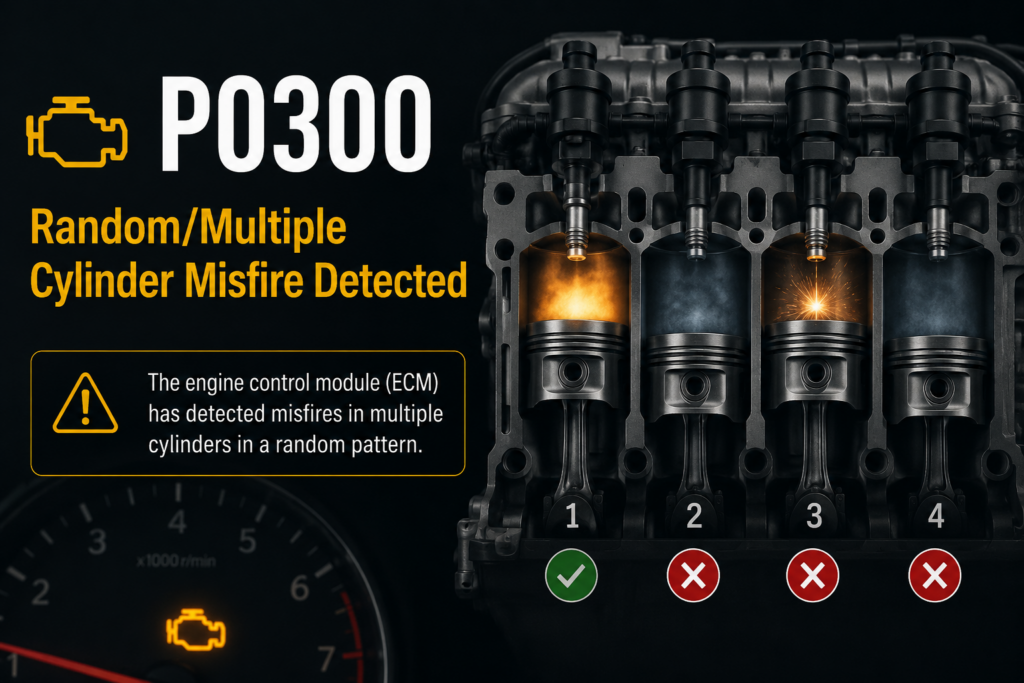
P0300 means your car’s computer detected a misfire, but couldn’t pin it to a single cylinder. It’s happening randomly, or across multiple cylinders at once. That’s what makes it frustrating to diagnose — it’s not “cylinder 3 is misfiring.” It’s “something is wrong, somewhere, and it keeps happening.”
The engine needs three things to run properly: spark, fuel, and compression. P0300 usually means at least one of those is failing — you just have to figure out which.
What You’ll Notice
- Engine shaking or vibrating, especially at idle
- Rough, uneven acceleration
- Check engine light on — sometimes flashing (flashing means it’s serious)
- Loss of power going uphill or under load
- Worse fuel economy than usual
- Occasional stalling or hesitation
A flashing check engine light specifically means the misfire is severe enough to damage your catalytic converter. If yours is flashing, don’t drive it any further than you have to.
What Usually Causes P0300
1. Worn spark plugs The most common cause by far. Old spark plugs misfire randomly as they wear out — not consistently enough to flag one specific cylinder, just enough to throw P0300. If you can’t remember when you last changed them, that’s your answer.
2. Failing ignition coils Each cylinder has its own coil. When one starts to fail, it doesn’t always fail completely — it just fires weakly and inconsistently. Can trigger P0300 even if only one coil is struggling.
3. Clogged or leaking fuel injectors If an injector isn’t delivering the right amount of fuel, combustion becomes unpredictable. The cylinder fires sometimes, doesn’t others. P0300 follows.
4. Vacuum leaks A cracked hose or failed gasket lets unmetered air into the engine, throwing off the air-fuel mixture. Often feels worse at idle and improves at higher RPM.
5. Low fuel pressure A weak fuel pump or a clogged fuel filter starves the engine of fuel under load. Hard acceleration becomes rough, and the misfire codes start showing up.
6. Low compression Worn piston rings, a burnt valve, or a blown head gasket can cause compression loss in one or more cylinders. This is the most expensive cause and usually comes with other symptoms like oil consumption or white smoke.
7. Bad crankshaft or camshaft position sensor These sensors tell the ECM exactly when to fire each cylinder. A faulty reading causes misfires that seem completely random — because to the engine, they are.
How Serious Is P0300?
Take it seriously.
A misfire doesn’t just feel bad — it sends unburned fuel into the exhaust, which destroys catalytic converters over time. It also puts extra stress on engine internals with every rough combustion cycle.
If the check engine light is flashing, stop driving as soon as it’s safe. A flashing light means the misfire is happening right now and is severe enough to cause immediate damage.
If the light is steady and the car is driveable, you have a bit more time — but don’t put it off for weeks.
How to Diagnose P0300
Step 1 — Read the full fault code list
P0300 rarely shows up alone. Check for companion codes like P0301, P0302, P0303 (specific cylinder misfires) alongside it. If you see P0300 + P0302, cylinder 2 is likely your main problem even though P0300 suggests randomness.
Step 2 — Check the spark plugs first
Pull them out and look. Black, oily, or heavily worn electrodes tell you a lot. If they’re past their service interval, replace all of them — not just one.
Step 3 — Test the ignition coils
Swap coils between cylinders and clear the codes. If the misfire follows the coil to its new cylinder, the coil is the problem. Many parts stores will also test coils for free.
Step 4 — Check for vacuum leaks
With the engine running, listen for a hissing sound around the intake manifold, throttle body, and vacuum hoses. A can of carburetor cleaner sprayed carefully around suspect areas can help locate leaks — the idle will briefly change when you hit the right spot.
Step 5 — Check fuel pressure
A fuel pressure gauge will tell you if the pump is keeping up. Compare your reading to spec — low pressure under load is a strong sign of a failing pump or blocked filter.
Step 6 — Compression test
If everything else checks out, do a compression test on all cylinders. Any cylinder significantly lower than the others points to an internal engine problem. This is the last step because it takes the most time — rule out the simpler stuff first.
How to Fix P0300
Replace the spark plugs — Start here. It’s cheap, it’s quick, and it fixes P0300 more often than anything else. Use the manufacturer-recommended plugs for your engine.
Replace a faulty ignition coil — Once you’ve identified the problem coil via the swap test, replace it. While you’re in there, it’s worth checking the others too if the car has high mileage.
Clean or replace fuel injectors — A good quality fuel injector cleaner added to the tank can help with minor clogging. For a more thorough job, professional ultrasonic cleaning or direct replacement is the way to go.
Fix vacuum leaks — Cracked hoses are cheap to replace. A leaking intake manifold gasket takes more labor but is still a manageable repair.
Replace the fuel pump or filter — If fuel pressure is low, a new filter is the first step. If pressure is still low after that, the pump needs replacing.
Head gasket or valve repair — If compression testing reveals a problem, this is the repair path. It’s the most involved and expensive fix on this list, but catching it early prevents a much costlier engine rebuild later.
What It Might Cost
| Repair | Estimated Cost |
|---|---|
| Spark plug replacement | $50 – $200 |
| Ignition coil replacement (single) | $80 – $300 |
| Fuel injector cleaning | $50 – $150 |
| Fuel filter replacement | $30 – $100 |
| Fuel pump replacement | $200 – $600 |
| Vacuum leak repair | $100 – $400 |
| Head gasket repair | $1,000 – $2,500+ |
Costs vary by vehicle make, model, and labor rates in your area.
Related Codes
- P0301 – P0308 — Specific cylinder misfire codes (check these alongside P0300)
- P0171 / P0172 — Lean or rich fuel mixture, often related
- P0340 — Camshaft position sensor circuit malfunction
- P0335 — Crankshaft position sensor circuit malfunction
Frequently Asked Questions
Can I drive with a P0300 code?
If the check engine light is flashing, no — pull over when safe and don’t drive it further. If the light is steady and the car feels driveable, you can drive short distances, but the longer you leave it, the more damage accumulates in the catalytic converter and engine.
Why is P0300 harder to diagnose than a specific cylinder code?
Because the misfire isn’t consistent enough for the ECM to blame one cylinder. It could be a fuel pressure issue affecting all cylinders, a sensor giving bad timing data, or multiple weak components all failing at once. That’s why the diagnostic process works through one system at a time.
Could bad gas cause P0300?
Yes, actually. A tankful of contaminated or very low-quality fuel can cause temporary misfires. If P0300 appeared shortly after filling up and your car normally runs fine, try running the tank low and refilling with quality fuel from a different station.
How do I know if it’s spark plugs or ignition coils?
Replace the spark plugs first — they’re cheaper and more commonly the cause. If the misfire continues, then move on to testing the coils. The swap test described above is a reliable way to identify a specific coil without buying a new one blind.
What happens if I ignore P0300 for too long?
The unburned fuel damages the catalytic converter, which is an expensive part to replace. The rough combustion also wears engine components faster than normal. What starts as a $50 spark plug job can eventually turn into a $1,500 catalytic converter replacement if left long enough.
This guide is for informational purposes only. For an accurate diagnosis, always consult a qualified mechanic.